Get email alerts on the Parks Master Plan topic
No spam. Unsubscribe anytime.
Commission backs Parks Master Plan policy updates and certifies mitigated negative declaration
Summary
The Planning and Transportation Commission recommended the City Council certify an initial study and mitigated negative declaration and adopt general plan amendments for San Carlos’s Parks Master Plan update; staff highlighted tribal consultations, a proposed community/aquatic facility at Loyola Park and a short/mid/long‑term implementation schedule.
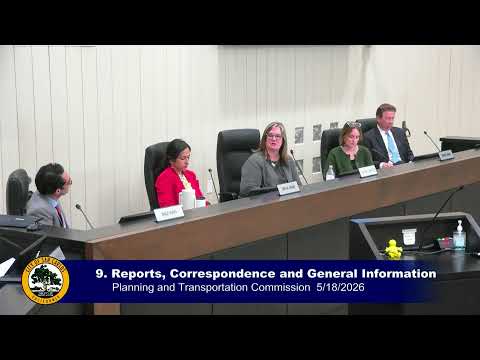
The Planning and Transportation Commission on May 18 recommended that the City Council certify the initial study and mitigated negative declaration (ISMND) and adopt amendments to the Parks & Recreation Element and Environmental Management Element that implement the updated Parks Master Plan.
Lisa Costa Sanders, principal planner, and Liv Nieder, environmental planner with consultant WRA, said the update implements recent state requirements (SB 1425 and AB 1889) to address equitable access to open space, climate resilience and habitat connectivity. Staff noted the plan reclassifies Loyola Park as a community park and emphasizes multigenerational and multiuse facilities, playground and accessibility upgrades, restroom additions and potential improvements to sports fields.
Consultant WRA summarized CEQA review: the ISMND was circulated April 17–May 18 and staff received one comment (Caltrans), which they addressed; the city carried out tribal consultations and, in response to tribal requests, included a land acknowledgment and measures requiring tribal monitoring and cultural‑resources awareness training for ground‑disturbing projects that could encounter subsurface deposits. Mitigation measures also cover construction‑period controls (erosion, dust), nesting bird surveys and paleontological awareness for sites with elevated potential.
Amy Newby, parks director, described funding sources for improvements—including Park‑in‑Lieu fees (Fund 27), the general fund capital budget, grants and partnership support from the Parks & Recreation Foundation—and said staff will prepare an implementation plan sequencing short‑term (0–5 years), mid‑term (5–10 years) and long‑term (10–20 years) projects. She said the council had asked staff to refine concepts for an aquatic/community facility and that council had directed staff to pursue a Loyola Park master plan that could include an aquatic facility.
Vice Chair Bundy moved, and the commission voted 5‑0, to recommend the council certify the ISMND and adopt the mitigation monitoring and reporting program. The commission subsequently voted 5‑0 to recommend council adopt the parks and environmental management element amendments. The Parks & Recreation Commission had previously recommended the Parks Master Plan to council; the Planning & Transportation Commission serves as the recommending body for the general plan amendments and CEQA findings.
AI generated
The text on this page is AI generated. Summaries, highlights, analysis, and video transcripts are all produced from the original source material.
AI can make mistakes, so if you spot one, and we will fix it for everyone.
Note: the source content is unaltered by us. Any content source we link to, be it a video, an audio recording, or a document, is presented exactly as its publisher released it. That publisher is usually a government body, sometimes an individual official or another organisation.