Get Full Government Meeting Transcripts, Videos, & Alerts Forever!
Get email alerts on the Municipal Autonomy topic
No spam. Unsubscribe anytime.
Mayors’ groups back House Bill 11‑84’s goals but demand amendments to protect municipal autonomy and finances
Summary
Representatives of the Federación de Alcaldes and the Asociación de Alcaldes told a House committee that House Bill 11‑84 to create a "Corredor del Norte" revitalization program has a legitimate purpose but must be amended to avoid centralizing permitting, protect municipal autonomy under Ley 107‑2020 and clarify fiscal compensation for lost municipal revenue.
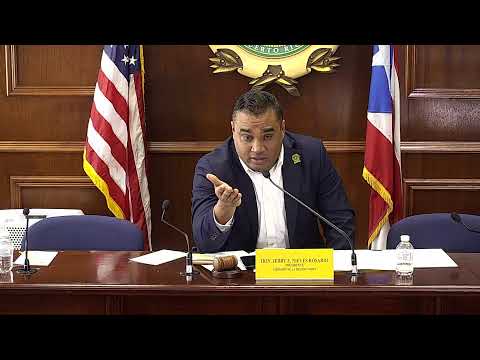
A House committee heard May 19 from municipal associations and a Barceloneta official who supported the goals of House Bill 11‑84 — to revitalize urban centers from Toa Alta to Quebradillas with mixed‑use development, tax incentives and expedited permitting — but urged changes to safeguard local control and municipal finances.
Ricardo Rolón Morales, representing the Federación de Alcaldes de Puerto Rico, said the federation “reconocemos la intención legítima de esta medida” but warned that as drafted the bill risks undoing the decentralization enshrined in Ley 107 de 2020 (Código Municipal). Rolón told the committee the proposal would “volver a concentrar funciones y estructuras” in central agencies by creating a new expedited permitting office (recorded in the hearing as OPE), and he flagged possible fiscal harm if municipal IVU (sales‑tax) and construction levies are reduced without a clear, permanent compensation mechanism for affected towns.
Verónica Rodríguez, executive director of the Asociación de Alcaldes de Puerto Rico, echoed those concerns and submitted specific amendment recommendations: require express municipal consent for any local tax exemptions, make participation in the program voluntary so each municipality can assess fiscal and operational capacity, use existing municipal permitting offices or voluntary intermunicipal consortia rather than a new centralized permitting body, and limit the central government’s role to technical support and coordination.
Lisandro Reyes, vice mayor of Barceloneta, told the committee his administration supports the bill’s intent to repopulate downtowns but urged practical safeguards. Barceloneta’s recommendations included limiting which industries and sizes of projects qualify for incentives, requiring that 50% of new employees come from the host municipality, and structuring incentive periods so municipalities evaluate compliance year‑by‑year within a five‑year window. Reyes said a five‑year term is preferable to shorter windows often suggested by others and stressed that municipalities must retain authority to verify patents (business licenses) and other compliance before renewing benefits.
Committee members also discussed legal constraints on declaring properties “estorbo público” (public nuisance/expropriation), with witnesses noting that the court‑based process requires due‑process safeguards and is intrinsically slow. Speakers pointed to existing municipal tools — ordinances such as "calles completas," local permitting offices, and intermunicipal consortia used by municipalities including Caguas, San Juan, Comerío, Mayagüez and Ponce — as alternatives to further centralization.
The associations urged that House Bill 11‑84 be evaluated alongside other pending legislative reforms to the permitting and planning system (cited in testimony as related senate and house bills) to avoid regulatory duplication or inconsistent structures. No formal vote or motion was taken at the hearing; witnesses were invited to submit written amendments and the committee recessed to receive additional municipal testimony.
The committee adjourned at noon with the record indicating the members will review the associations’ memorials and proposed changes before further action on the bill.