Get Full Government Meeting Transcripts, Videos, & Alerts Forever!
Get email alerts on the Land Use Preservation topic
No spam. Unsubscribe anytime.
Martin County OKs Pine School preserve plan change after staff review and public comment
Summary
The commission unanimously approved an amendment to the Pine School Preserve Area Management Plan that shifts and consolidates preserve acreage, removes about 2.16 acres for a relocated entrance and athletic facilities and adds roughly 17.14 acres of upland scrub preserve for a net increase of about 6 acres of preserved scrub habitat.
Sean McCarthy, a planner in the environmental division of the Growth Management Department, told the Board that the Pine School has applied to amend its 2005 Preserve Area Management Plan (PAMP) to modify preserve configurations tied to a revised final site plan. McCarthy said the property comprises roughly 173 acres of which about 138 acres were identified as native uplands in 2005; of that, 46.28 acres were originally established as upland preserve. McCarthy said the amendment would remove approximately 11.07 acres of existing upland scrub preserve and add about 17.14 acres elsewhere, yielding a net increase of roughly 6.07 acres of preserved scrub habitat, and that staff found the amendment satisfies Martin County code and the comprehensive growth management plan.
Morris Crady, a senior partner with Lucido and Associates who worked on the original 2005 design, explained that the application would relocate the existing US‑1 entrance and remove about 2.16 acres adjacent to the roadway for the relocation; an additional 8.91 acres adjacent to Banner Lake were identified for potential future expansion but would not be cleared until future site‑plan approvals. Crady said the proposal consolidates preservation into a larger, more contiguous area in the southeast portion of the property, which consultants identified as the most viable scrub habitat.
Toby Oberdorf of Haley Ward described ecological surveys completed for the site — including two Scrub J surveys and gopher tortoise burrow mapping — and said the applicant coordinated survey methodology and a draft relocation plan for the federally endangered lichen Cladonia perforata with the U.S. Fish and Wildlife Service. Oberdorf quoted the agency’s response, saying, “the draft relocation plan looks great. What a great idea to involve the students.” He emphasized that no land clearing or site work will occur until relocation plans, maps and required state or federal permits are finalized and reviewed by county staff.
Commissioners asked detailed questions about who approves relocation plans and how federal versus state protections apply. McCarthy and Paul Schelling, the county’s growth management director (on the record), said county staff will require final relocation plans and maps prior to any land clearing, and that permits and coordination with the appropriate state and federal agencies will be necessary for gopher tortoise relocation and any federally listed‑species work. On costs, Oberdorf offered preliminary relocation estimates: $400–$750 to excavate a gopher burrow, $5,500–$10,000 per tortoise for admission to an off‑site conservation bank, and higher per‑tortoise estimates for managed on‑site relocation (applicant estimated a rough package cost of about $8,000 off‑site versus about $20,000 on‑site).
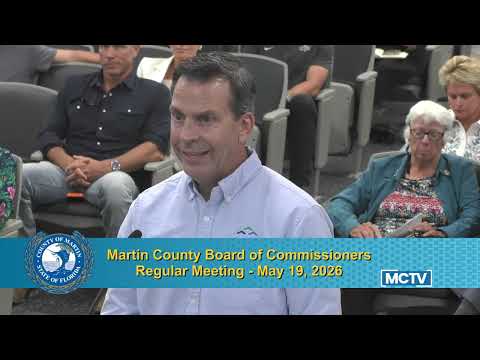
Members of the public and the local conservation community addressed the board. Anne Cox of the Martin County chapter of the Florida Native Plant Society asked that listed plants be mapped and expressed concern about whether relocation will be successful for species that are rare and have specialized habitat needs; she asked the board to consider a continuance to allow additional mapping and input. Speakers from the Pine School — staff, parents and students — described the school’s stewardship work at Banner Lake, student education opportunities tied to restoration and the school’s offer to fund enhancements and to expand preserved acreage. Beth Lettingarver, the school’s director of enrollment management, said the plan “adds a net plus 5 acres of quality, upland protected habitat,” and other school speakers highlighted student involvement and local partnerships.
After discussion emphasizing monitoring, coordination with state and federal agencies, and the educational benefits of on‑site stewardship, Commissioner (speaker 8) moved to accept staff’s environmental recommendation and Commissioner (speaker 28) seconded. The board voted unanimously to approve the PAMP amendment and the consolidated preserve configuration. Chair Hurd declared the motion passed. The board directed that final relocation plans, maps of endangered plant locations and any required permits be submitted to county staff and that no clearing occur until staff signs off and necessary permits are in hand.
What’s next: The approval permits the applicant to proceed with the preserve amendment as described, subject to the condition that relocation and mitigation plans for listed species be finalized and approved by county staff and relevant agencies before any clearing or construction activity begins.