Get Full Government Meeting Transcripts, Videos, & Alerts Forever!
Get email alerts on the Elections topic
No spam. Unsubscribe anytime.
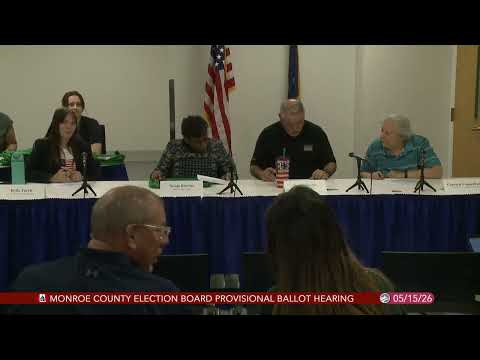
Monroe County election board reviews 62 provisional ballots from May primary, accepts many and rejects others
Summary
Monroe County election officials reviewed 62 provisional ballots from the May 5, 2026 primary, accepting ballots that were cured, issued in error, or from travel‑board nursing‑home voters, and rejecting ballots for wrong precincts, missing ID, late registration or uncured signature problems.
Monroe County election officials convened at 12:01 p.m. to review 62 provisional ballots cast in the May 5, 2026 primary, accepting multiple ballots after staff verified cures or administrative errors and rejecting others for ineligibility.
The board’s chair opened the session and said the purpose was to “cure or clarify provisional ballots” from the primary. Agency staff reported the total of 62 provisional ballots and walked the board through each polling-site packet and the accompanying paperwork. Kylie, a staff member assisting the board, provided registration lookups and evidence of cured identifications and forms.
The board accepted provisional ballots when voters presented identification within the 10‑day cure period or when the ballot was issued because of a poll‑book or staff error. For example, agency staff said two early‑voting provisional ballots (voter numbers 1 and 2) had lacked ID at the time of voting but “have since presented identification,” and the board voted to accept those ballots. The board also accepted voter 18 after staff confirmed the voter presented ID in time, accepted voter 31 after the voter brought ID to cure the provisional, and accepted several ballots that county staff classified as travel‑board (nursing‑home) ballots (voters 59–62) because those voters should have received regular ballots rather than provisionals.
Conversely, the board rejected provisional ballots when staff found voters were registered in other counties, had not presented identification within the cure window, registered after the statutory registration deadline for the primary, or were voting at the wrong polling site. Agency staff identified multiple rejections: voters registered in Marion, Owen, Lawrence, Lake, Hendricks, Morgan and Allen counties were rejected as not eligible to vote in Monroe County’s primary; specific rejections included voter numbers 4, 8, 9, 11, 12, 14, 16, 17, 19, 20, 21, 22, 23, 24, 25, 26, 27, 28, 29, 32, 33, 34, 35–38, 40, 41, 42, 45, 55, 56, 50 and 58 where motions to reject were made and the board voted aye.
The board also handled signature and missing‑signature issues. Two missing‑signature cases (voters 46 and 47) returned cure forms within the deadline and were accepted. Under the mismatched‑signature review, the board accepted ballots 48, 49, 51, 52, 53 and 57 after the voters returned corrected forms or the staff verified household‑level corrections; the board rejected ballots 55 and 56 for failing to cure. In one contested signature review (voter 54), staff compared older signatures and recent submissions and the board voted to accept voter 54’s ballot.
During the meeting a staff member explained the county’s cutoff for primary eligibility, noting “the deadline was April 6” for registration changes affecting primary eligibility; the board repeatedly stated that voters who registered after that date would be eligible for the general election in November but not the primary. Agency staff said where a voter’s driver‑license address did not match the poll book it did not by itself make the ballot invalid; the decisive criteria were precinct and registration status.
A separate administrative matter arose when a board member asked whether parties to a prior, tabled complaint should be notified. The board voted to notify complainants and respondents that the complaint was received and remains tabled.
The board recessed while staff completed paperwork; upon reconvening staff reported that adding accepted ballots did not change the totals affecting any contest. The chair then moved to adjourn and the board voted to adjourn.
What the board did (selected actions): the board explicitly moved and voted to accept provisional ballots 1, 2, 7, 18, 31, 43, 44, 46, 47, 48, 49, 51, 52, 53, 54, 57 and travel‑board ballots 59–62; it moved and voted to reject numerous provisional ballots for wrong precinct, missing ID, late registration after April 6, or uncured/mismatched signatures (examples listed above). Motions and seconds were taken on the record for each packet review and recorded as aye votes.
The meeting record shows the board repeatedly relied on staff verification (Kylie and other agency officials) and on poll‑book checks to determine eligibility. The board’s action list and the staff paperwork will be attached to the official meeting minutes for the formal record; staff indicated affected voters who were ineligible for the primary remain eligible for the general election if they maintain county residency.
The board’s next procedural step was administrative: staff will finalize and attach the accepted/rejected ballots and associated cure forms to the official files. The meeting recessed while staff completed those tasks and then the chair adjourned the meeting.
(Quotations in this article are taken verbatim from the meeting transcript; attributions use the board’s internal labels: “Chair,” “Agency official,” “Committee member,” and “Kylie (Staff member)”.)