Get Full Government Meeting Transcripts, Videos, & Alerts Forever!
Get email alerts on the Healthy Buildings Implementation topic
No spam. Unsubscribe anytime.
Evanston advisory group advances work plan for Healthy Buildings implementation, debates 80% AMI cutoff for equity-prioritized buildings
Summary
An Evanston advisory group reviewed a draft work plan for implementing the Healthy Buildings Ordinance, heard a public comment warning that strict simultaneous standards could raise rents, and discussed a proposal to designate equity-prioritized buildings mainly as affordable housing and community-serving nonprofits with an 80% AMI test; no votes were taken due to lack of quorum.
Acting chair opened the meeting and noted there was no quorum, so the group would not take formal action but would review a draft work plan and continue work over the summer.
John Kozlowski, representing the Chicago Land Apartment Association, used the public-comment slot to warn that the ordinance’s current structure — which requires energy efficiency, zero greenhouse-gas emissions and 100% renewable electricity simultaneously — will raise operating costs and put upward pressure on rents. Kozlowski said, “If there isn't another way for residential buildings to comply with it, operating costs are going up, and you know already that that puts upward pressure on rents.” Acting chair and staff offered to follow up with Kozlowski for further input on alternative-compliance options.
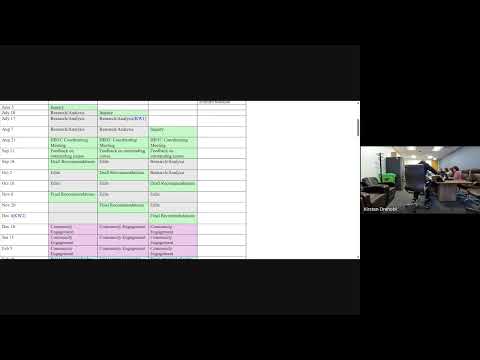
The core of the meeting focused on a draft work plan organized into three buckets: defining equity-prioritized buildings (EPBs), identifying benefits and alternative-compliance options for those buildings, and designing review and application processes. Committee members recommended starting informal community engagement in the summer with focus groups and one-on-one meetings rather than waiting until late in the year. The work plan schedule described in the meeting envisions draft recommendations prepared by November and additional engagement through December, with finalization discussions in February–March.
On EPB definitions, the chair presented a straw-man proposal to concentrate EPB status on (1) affordable housing and (2) community-serving nonprofits that own buildings. For multifamily rentals the proposal would classify a building as an EPB if a majority of units are affordable to households at 80% of area median income (AMI); properties could demonstrate that either by resident income documentation (common for subsidized housing) or by rent-based thresholds tied to HUD/IDA tables. Housing staff noted that AMI calculations use metro-area figures and offered to provide Evanston-specific cross-tabs. Housing staff reported rough counts for covered properties: “a little over 3,000” condo units, about 10,000 rental units, roughly 222 covered rental buildings and 52 covered condo buildings — about 14,000 units in total under the current coverage list.
Committee members pushed back that choosing 80% versus 100% AMI matters for locally cost-burdened households: one member noted that about 30% of households at 100% AMI are cost-burdened in Evanston and urged the group to check local data before fixing the threshold. Housing staff agreed to run more localized analyses to show how different AMI cutoffs would affect building counts and cost-burden exposure.
Members also discussed condos as a distinct implementation problem. The chair proposed pushing condo compliance timelines later than rentals to allow targeted outreach and technical work on metering and governance questions; some members said council would likely want a single package of final rules, so the group should balance implementation practicality with political considerations. Several members suggested soliciting alternative-compliance applications from condo owners as pilots to learn how the process would work in practice.
The committee supported including community-serving nonprofits (examples cited: houses of worship, YMCA/YWCA, childcare centers) as EPBs where the building’s primary use is direct community services. Members noted many nonprofits do not own buildings, which limits the pool of eligible sites, and discussed whether city-owned facilities or private schools should be handled as EPBs or through alternative compliance.
Throughout the discussion members emphasized pairing research and analysis with stakeholder conversations, using small informal sessions early and reserving larger formal outreach for later stages. No motions or votes were taken because the meeting lacked a quorum; the group agreed to continue work in June and to run additional data analyses and targeted outreach over the summer.
Next steps: staff will provide finer-grained AMI and building-stock cross-tabs, the authors will revise the EPB proposal (including reconsidering 80% vs. 100% AMI), and the committee will schedule summer outreach (focus groups, one-on-ones and condo-focused sessions) before returning to the proposal in a future meeting.