Get Full Government Meeting Transcripts, Videos, & Alerts Forever!
Get email alerts on the Instructional Technology topic
No spam. Unsubscribe anytime.
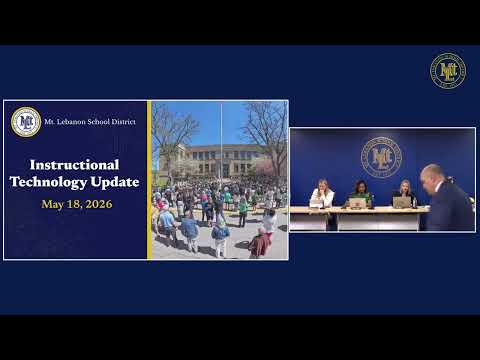
Mount Lebanon School District outlines classroom-first technology plan and AI guardrails
Summary
At its May 18 board meeting, district leaders and teachers described how technology supports learning — stressing limited, intentional use, new AI policies and a shift to iPads for younger grades — and answered community questions about privacy, filtering and vendor claims.
At a May 18, 2026 Mount Lebanon School District board meeting, administrators and classroom teachers presented a multipart update on instructional technology that emphasized technology as a teaching tool, tighter safeguards around artificial intelligence and planned device and training changes for next year.
"Technology is a tool in our teachers' repertoire, and technology alone does not achieve the outcomes described in our profile," Dr. Davis told the board as the presentation opened, framing the district's approach around a six-theme "profile of a learner." Presenters tied classroom examples to that profile, showing how tools are selected to support skills such as collaboration, critical thinking and digital literacy.
Elementary and secondary leaders walked through specific uses and limits. Dr. Jason Ramsey described elementary practices, saying classroom tools are intentionally limited "less than 1 hour per week per tool" and that most instruction remains hands-on. High-school principal Dr. Joel Thompson outlined secondary tools including IXL, Firefly and Schoology and described protocols to prevent overuse, such as teacher-directed device routines.
Teachers gave concrete demonstrations. Mikaela, a Hoover Elementary first-grade teacher, described student-created mini-podcasts and QR-coded displays shared via Schoology; Madie Kirk, a fourth-grade Foster teacher, said Schoology serves as a communication hub for parents and students; and Josh Bilak, a physics teacher, described students building custom study chatbots and reflecting on ethical use.
The district also explained governance and safety measures. The board was told the district adopted policy 8.15.1 to set AI guardrails and used the RAIL (Responsible AI and Learning) endorsement process to guide literacy, ethics and safety instruction. Chris Stengel, director of technology, outlined infrastructure and filtering tools in place or being expanded — naming GoGuardian and Gaggle for monitoring, a district-created "Tab Warden" to limit open tabs, and restrictions on YouTube and AI features in Google Suite for K–8. "GoGuardian is in place," Stengel said, describing both blocking and alert functions that notify school administrators.
Administrators presented the instructional-technology software budget and breakdown: the software portion totals $850,330, which the presentation noted is less than 1% of the district's overall budget and is primarily for district operations and staff accounts.
Planned changes and next steps include moving second graders to iPads next school year (with K–1 already on iPads), adding an instructional-technology coach in each elementary school, signing families up for GoGuardian Parent access next fall and continuing professional learning and vetting for apps and data-privacy practices.
During public comment, some community members urged further scrutiny. Parent Matthew Hackworth questioned statements about vendor functionality, saying, "I heard that IXL teaches you what you did wrong. I was like, did I hear that right? Because that is not true." Another commenter, Nat McLean, urged stricter device limits and suggested removing personal devices at younger grades.
Board members praised the presentations and noted learning-walk observations in classrooms. The district said the presentation materials and an appendix with application lists, filtering tables and software costs will be posted online and that the board will continue to monitor the program and community feedback.
The board opened the floor to questions at the end of the presentation; several implementation steps — device rollouts, GoGuardian enrollment and committee meetings with student councils — were scheduled to continue over the summer and into the coming school year.