Get Full Government Meeting Transcripts, Videos, & Alerts Forever!
Get email alerts on the Utilities topic
No spam. Unsubscribe anytime.
Bay City Commission hears utilities budget; electric, sewer and a $5M water loan for lead line replacements highlighted
Summary
City staff presented the utilities portion of the proposed budget, reporting a $5M increase in the electric fund largely driven by planned capital spending and an $8.1M planned use of reserves; the commission heard that a $5M DWRF loan/grant will fund lead service-line replacements.
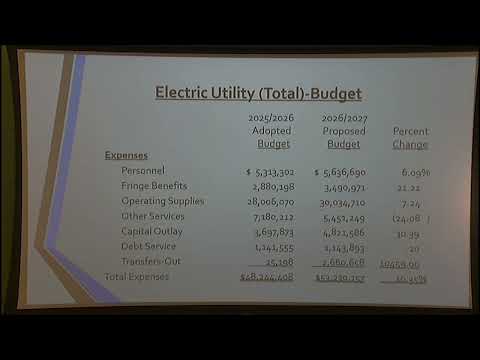
City commissioners on the dais heard a detailed presentation of the utilities budgets that will shape next fiscal year’s spending. George Martini, the presenter, told commissioners the electric utility’s total expenditures rise from about $48 million last year to roughly $53.2 million in the proposed budget, but that includes an $8.1 million planned draw on fund balance; cash collections are closer to $45 million. Martini said the planned draw is intended to fund capital projects rather than reflect a sustained jump in operating costs.
Commissioner Cubitt pressed Martini to confirm that the budget increase reflected planned use of reserves rather than a uniform 10% rise in system operating costs; Martini repeated that the department purposely built reserves and that this year’s increase reflects capital spending and modest rises in purchase power and personnel costs. Adam, an electric department staffer who addressed the commission, said the city buys power through the Michigan Public Power Agency (MPPA) and noted ongoing litigation and a pending FERC proceeding over how certain power‑plant costs are allocated; those matters, he said, could affect future cost allocations but were unresolved at the time of the presentation.
Martini outlined expense drivers for the electric fund: purchase power, operating supplies, a roughly 6–7% rise in personnel and associated fringe benefits (retiree health and healthcare), and capital outlays including substation work and a spare transformer currently on order. He said a rate analysis is planned this year and that the use of reserves could temper any near‑term rate increase.
On sewer, Martini reported that a large trickling‑filter replacement project is finished; the project was funded in part by ARPA and reduced heavy fund‑balance use. He said the sewer department received an EPA grant for work on the Marquette Interceptor that will support installation of gates to mitigate flooding.
For water, Martini said the city has been awarded a $5 million package from the Drinking Water Revolving Fund (DWRF) structured as a loan/grant mix (approximately $2.5M repayable) that will be used exclusively for replacing lead service lines. Staff estimated roughly 3,200 lead service lines remain; per‑line replacement costs range from about $2,500 to as much as $10,000 depending on conditions. Martini said the city has already replaced about 11,000 lines from an original 14–15,000 and has used ARPA funds and other local dollars to support the program. Commissioners asked about timelines; staff indicated lead-line work is multi‑year and compliance deadlines extend into the 2030s.
Martini also noted that ARPA balances are nearly exhausted: the city projects approximately $1.4 million remaining at June 30 with a December 31 deadline to obligate or return funds.
The presentation closed with staff identifying several capital projects planned across utilities (peaking plant work, substation construction, meter replacement, cathodic protection for water mains and line replacement budgets) and the commission moved to questions and later business.