Get Full Government Meeting Transcripts, Videos, & Alerts Forever!
Get email alerts on the Waste Management topic
No spam. Unsubscribe anytime.
Adams County committees approve engineering funding, declare intent for up to $7M in notes for leachate treatment project
Summary
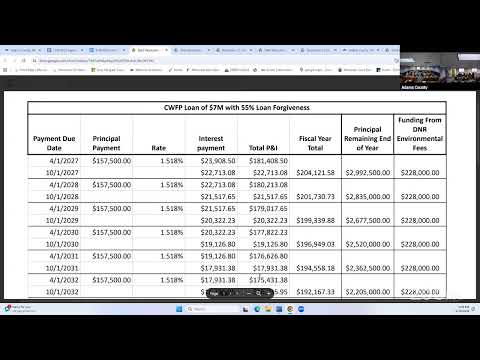
On May 19, 2026 Adams County’s joint Solid Waste and Administrative & Finance committees approved a $509,800 engineering contract proposal and passed a resolution declaring intent to issue up to $7 million in promissory notes to support a proposed reverse-osmosis leachate treatment system and a Clean Water Fund application.
Adams County’s joint Solid Waste and Administrative & Finance committees voted May 19 to amend the 2026 Solid Waste Fund and to declare the county’s intent to issue up to $7,000,000 in general obligation promissory notes as part of a Clean Water Fund application to install a reverse‑osmosis (RO) leachate treatment system.
The committees approved a budget amendment to fund engineering services after staff disclosed a proposal from Tetra Tech priced at $509,800 to fully engineer the proposed wastewater treatment facility. “Leachate is essentially rainwater that comes in contact with solid waste, … picks up different contaminants,” said Jalen Thomas, certifying engineer with Tetra Tech, explaining why the county is pursuing an on‑site treatment option rather than continued hauling to downstream wastewater plants.
Thomas and a Tetra Tech colleague outlined the regulatory pressure driving the project: increasing limits and enforcement for PFAS (per‑ and polyfluoroalkyl substances), a state Board order (referenced in the presentation) and a Wisconsin Supreme Court decision expanding the Department of Natural Resources’ authority to require cleanup even without numeric standards. Thomas said conventional wastewater plants “do nothing for PFAS treatments,” and that several local plants the county uses — including the City of Adams and the village of Plover — face capacity or permit constraints.
A feasibility study completed for the county evaluated multiple technologies and recommended reverse osmosis as the most cost‑effective, scalable option for Adams County’s site, officials said. The consultants presented capital and 20‑year operations estimates; preliminary slide figures cited annual operations north of $400,000 and a per‑gallon operating estimate in the range discussed during the presentation.
Committee members pressed staff on alternatives, life expectancy and whether the system would accept leachate from other counties. Tetra Tech said the system is sized primarily to serve Adams County; accepting outside leachate would require additional ordinances and was not part of the current Clean Water Fund application. The on‑call consultant said the 20‑year planning horizon is a budgeting assumption and that proper maintenance could extend the facility’s service life beyond the loan term.
Several members urged delaying county action until new board members had more time to review the study. Supervisor Shelton moved to send the item back to the Solid Waste Committee for further review; staff cautioned that missing the Sept. 30 application deadline would forfeit eligibility for principal forgiveness under the Clean Water Fund. The committee held a roll‑call vote on the referral motion and the chair announced the motion was defeated.
After further debate, the committee approved the budget amendment to fund the engineering work and later approved a separate resolution declaring the county’s intent to issue up to $7,000,000 of general obligation promissory notes — a required piece of the Clean Water Fund application that signals the county’s plan to reimburse project expenditures from future borrowing if awarded the loan. Staff said the application conservatively assumes 55% principal forgiveness though program rules allow higher forgiveness in certain pools and that current draft plans indicated increased principal‑forgiveness ceilings for the fiscal year.
The joint meeting adjourned and the board proceeded into the committee‑of‑the‑whole meeting scheduled for 5:06 p.m.
Votes at a glance: committees approved a budget amendment to pursue engineering for the RO system and approved the resolution declaring intent to issue up to $7,000,000 in promissory notes for the project. A motion to refer the matter back to committee was defeated during the meeting.