Get Full Government Meeting Transcripts, Videos, & Alerts Forever!
Get email alerts on the Work Plan topic
No spam. Unsubscribe anytime.
Evanston committee forwards 2026–27 housing work plan to council and urges mayoral task force to speed implementation
Summary
The Housing and Community Development Committee voted May 19 to send the draft 2026–27 work plan to City Council and recommended creation of a mayor-appointed task force to help implement priority housing initiatives, including production targets, ADU support and anti-displacement measures.
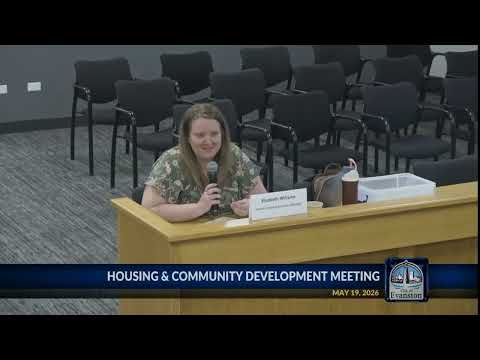
The Housing and Community Development Committee voted May 19 to forward the draft 2026–27 housing work plan to the Evanston City Council and recommended that council consider creating a mayor-appointed task force to accelerate implementation.
Chair Burns moved to include a recommendation to council that it discuss forming a task force alongside the staff-submitted work plan, saying, “I would love to send a recommendation along with that” to ensure the council sees committee feedback as it considers next steps. The motion was seconded and approved by voice vote.
Why it matters: Staff told the committee the plan incorporates amendments the City Council adopted on May 11 and adds council-requested items—most notably mandatory high-level cost evaluations for new initiatives, a 10-year production target broken down by income level, and expanded partnerships. Staff emphasized the document is a guiding, iterative tool that maps research (yellow), anticipated legislative steps (orange) and eventual program launches (green).
What staff said: A city staff member summarized the changes and how the plan will be used, saying staff included council-approved amendments and an updated action plan for the committee’s review. On the cost-evaluation additions, staff said evaluations are intended to quantify impacts on program delivery and on homeowner and renter costs so decision-makers can “make informed decisions” rather than using the review as an automatic veto.
Key additions and debates: Committee members pressed staff on several specifics. Members asked whether a cost-evaluation that showed higher-than-expected costs would automatically halt an initiative; staff said such findings would inform decisions but would not automatically stop a proposal. The committee also discussed production targets by income, collaboration with Northwestern University and local school districts to address student and faculty housing, pilot models for dormitory-style non-collegiate housing, and a possible vacancy tax—items staff said align with the city’s comprehensive planning work.
Members raised implementation and equity concerns. Committee members asked how community feedback would shape timing and whether some initiatives (for example, renter protections or property-tax relief) should receive priority. Member Murray urged prioritizing actions that add housing units at multiple income levels and recommended a task force that can help choose pragmatic, near-term moves. Members also sought improved data tracking: deconversion (multiunit-to-single-family conversions), rental registration and permitting systems were discussed as ways to better identify displacement trends.
Task force proposal: Chair Burns proposed a mayor-appointed task force focused on program design and administration to work alongside staff and the committee. Members debated scope and composition—suggesting program administrators, subject-matter experts, contractors, and retirees with relevant experience—and emphasized that the task force should be given clear questions and time-limited objectives to avoid delay. Staff offered to draft a proposed structure and focused questions for council consideration.
Next steps: The committee approved forwarding the work plan and the recommendation that council discuss creating a task force. Staff will incorporate the committee’s feedback into the packet for City Council. The committee and staff said status updates on implementation will be provided regularly (staff suggested roughly every other month) and individual initiatives that require ordinance or program changes will, as always, be brought to council for authorization.
Ending: The committee approved the motion by voice vote and moved on to a separate agenda item. The work plan will be included in the Council packet along with the committee’s recommendation on a task force.