Get Full Government Meeting Transcripts, Videos, & Alerts Forever!
Get email alerts on the Posted Signs topic
No spam. Unsubscribe anytime.
Ann Arbor planning staff: on-site development notice signs required starting July 1
Summary
City planning staff explained new on-site development notice sign rules that take effect July 1, covering required content, minimum size and placement, materials, posting/removal timelines and verification procedures; staff will accept template feedback before implementation.
City of Ann Arbor planning staff explained new on-site development notice sign requirements that take effect July 1 and answered attendee questions during an informational webinar.
Emma Berger, an associate planner, said the rules require applicants to post a proposed development notice sign on each site frontage for petitions submitted to the planning commission and other petition types. "New signage requirements are coming for development projects in the city of Ann Arbor," Berger said, adding that city council approved posting duration, placement and content requirements in February 2026.
Berger outlined the minimum content that must appear on the sign: the project file number, project address(es), the applicant name and contact information, the site's current zoning designation and a description of the proposed project, including uses and petitions. The sign may also include a QR code or URL linking to the project's page on the city's Engage site for additional details and contact information.
Staff described minimum size and placement standards: signs must be at least 3 feet wide by 2 feet tall, visible from the public right of way, placed at least 2 feet above grade (with the top of the sign about 4 to 6.5 feet above grade) and posted within 10 feet of the property line except where doing so would conflict with a 10-foot vehicular sight distance area. "There will be one sign per frontage in a prominent location," Berger said.
On materials and construction, staff recommended durable, all-weather materials: corrugated plastic 10–12 millimeters thick affixed to stakes or 15–18 ounce vinyl with grommets and zip ties attached to fences, and metal or wooden posts for freestanding signs. Staff also noted signs posted under this requirement are exempt from the city's existing sign code requirements.
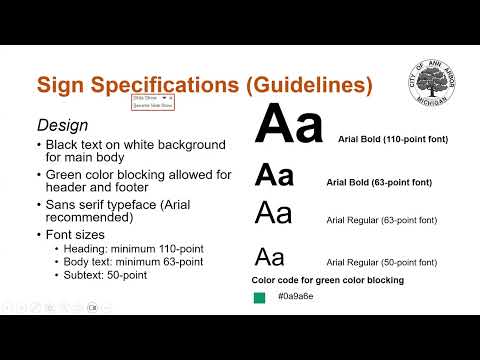
The presentation included legibility guidance: high-contrast design (black text on white background), optional green color blocks for headings, and a sans-serif typeface with Arial recommended. Berger provided suggested font sizes for headings, body text and subtext to help ensure readability.
Berger and colleagues explained timelines and verification procedures: for Type 1 projects that require a community participation meeting, signs must be posted 15 days before that meeting and removed within 15 days after a building permit is issued or if the application is denied or withdrawn. For Type 2 projects the posting and removal timing is tied to planner acceptance and subsequent permit issuance, denial or withdrawal. Applicants are responsible for arranging sign production and placement and must email photographic proof of the posted sign to their assigned planner; applications without verification may be paused and not scheduled for planning commission review.
Hank Kelly, deputy planning manager, said staff will request applicants send anticipated sign designs to planners before printing so staff can confirm compliance. "We do request that you send the anticipated signage to staff," Kelly said, noting planners will verify materials, location and placement and accept photos of the installed sign.
During the question-and-answer session, staff clarified other practical points: signs must be installed on the project site (not in the public right of way), applicants must replace vandalized or destroyed signs to maintain a legible posting for the required duration, and multiple frontages require a separate sign for each frontage. Staff also said the new rules apply only to applications submitted on or after July 1 through the Stream system and do not apply to projects already in process or already approved before that date.
Berger said the staff-provided templates and guidelines are open for feedback before the implementation date and that the webinar recording, slide deck, templates, FAQs and a local vendor list will be posted on the city's Engage page and the development review page for reference. Berger identified the unpublished amendment in the city's code as "ordinance 2602, community participation posted signs" and said details are available at a2gov.org/udc.
The webinar closed with staff inviting comments and questions through the Engage page and the Q&A feature; staff encouraged applicants to submit design proofs and noted they will review and incorporate feedback into the templates ahead of the July 1 effective date.