Get Full Government Meeting Transcripts, Videos, & Alerts Forever!
Get email alerts on the Udo Amendments topic
No spam. Unsubscribe anytime.
Planning commission backs UDO text amendments including floodplain, solar farm and sign rules
Summary
At its May 18 meeting the DeKalb Planning and Zoning Commission unanimously recommended City Council approve grouped text amendments to the Unified Development Ordinance affecting commercial uses, accessory buildings, sight-distance rules, solar farm fencing/landscaping, street-tree requirements and floodplain provisions — including cumulative substantial-damage calculations and a 2-foot freeboard for nonresidential structures.
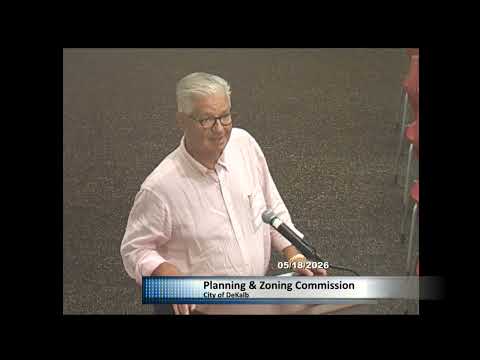
Chair McMahon opened a second public hearing at 6:20 p.m. on proposed miscellaneous text amendments to Chapter 23 (the Unified Development Ordinance). Staff said the package groups routine cleanups and clarifications across Articles 5 (General Commercial), 7 (Supplemental District Regulations), 9 (Streets and Sidewalks), 11 (Floodways/Floodplains) and 13 (Signs).
Planning staff (Dan) described several non-substantive and substantive edits: removing parking lots/structures from the list of permitted principal uses in the GC district (they remain a special use if principal); allowing the building services director discretion to approve accessory buildings or paved surfaces that exceed the current 30% rear-yard limit based on lot configuration and open-space criteria; and codifying field-visit flexibility for sight-distance triangles at intersections where elevation or existing conditions make the measured triangle overly restrictive for signage.
On renewable-energy siting, staff proposed that new in-city solar farms use either chain-link or wrought-iron fencing (up to 8 feet) and plant one screening tree per 30 feet of street frontage; staff noted existing approved or constructed solar farms are grandfathered and would not be retroactively required to change fencing.
The city engineer, John Laskowski, presented a detailed floodplain-management briefing and several proposed changes. He explained floodplain terminology (floodway, flood fringe, 100‑year/1% flood) and the city's participation in the National Flood Insurance Program and its Community Rating System (CRS). "We're a class 7" in the CRS, Laskowski said, and staff is seeking clearer ordinance language to preserve or improve that rating.
On proposed regulatory changes Laskowski outlined three main items: (1) make substantial-damage/substantial-improvement calculations cumulative so separate partial damages can aggregate toward the 50% market-value threshold that triggers compliance with current floodplain standards; (2) require non‑erodible foundations (rock or clay) where new construction occurs in regulated flood areas; and (3) apply a 2‑foot freeboard (top-of-foundation at least 2 feet above base flood elevation) to commercial and industrial structures when newly built or rebuilt following demolition. He also described a "hydraulically connected" definition and a compensation requirement for fill placement, noting staff would require more excavation than fill placed (staff cited a 110% compensation example) to avoid increasing net floodplain volume.
Commissioners asked how the cumulative substantial-damage threshold would be enforced; staff said rebuilding permits would be reviewed against the new standard and a permit could be denied if the threshold were met and the owner refused required improvements. The commission asked about applicant costs and hardship; staff noted prior nonconforming and permit processes and said the change is primarily intended to reduce repeated flood losses and emergency response burdens.
After public hearing closure and additional technical Q&A (sight-triangle measurement from property lines, evergreen screening for solar farms, and grandfathering of existing sites), Commissioner Wright moved and Commissioner Shali seconded that the commission recommend City Council approve the proposed UDO text amendments as shown in Exhibit A. The commission approved the motion unanimously on roll call.
The amendments are a recommendation to City Council; any changes to the municipal code must be adopted by ordinance at council. Staff indicated FEMA will audit CRS activities this year and that clarified, codified regulations will help the city's participation in the NFIP and its CRS status.