Get Full Government Meeting Transcripts, Videos, & Alerts Forever!
Get email alerts on the Land Use topic
No spam. Unsubscribe anytime.
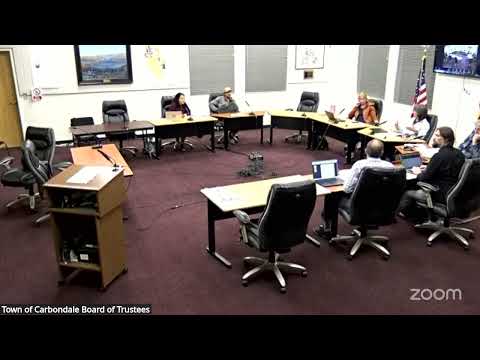
Planning commission and trustees debrief ADU process and outline two‑phase parking study for downtown
Summary
The Planning & Zoning Commission said its seven‑month ADU review produced useful options but flagged communication gaps; trustees and commissioners agreed to pursue a two‑phase parking study (inventory/code analysis then community engagement) with staff drafting an RFQ and a possible consultant budget of $25k–$30k for phase 1.
Nicholas DeFrank, chair of the Planning & Zoning Commission, told trustees the commission spent months on accessory dwelling units and that the process ‘‘was a significant effort’’ that produced helpful, iterative options for the town.
"This commission put in a I think it was 6 months, 7 months of effort into that," DeFrank said, and he and other commissioners urged clearer benchmarks and interim check‑ins so future multi‑month policy work is less likely to feel like “one big dump” on volunteers.
Trustees and commissioners also focused on short‑term rentals in the ADU code. Ross, the town’s board representative to the Ruedi authority and a frequent speaker at meetings, said safeguards were included so the town would not treat an ADU as an automatic right to short‑term renting: "at no point, in an applicant's process or in an applicant's journey to build an ADU is there an assumption that there's a right to a short term rental?" he said.
A second major discussion was a proposed two‑phase parking study. DeFrank described phase one as an inventory and comparative code analysis with a modest consultant fee (the commission discussed figures around $25,000–$30,000) followed by a larger community‑engagement phase if the town proceeds. "We put a number of, like, 25 or $30,000 on it to really come in and have a consultant really just reflect back to the town," he said.
Trustees asked whether code relief for a particular project — such as the town center development — could proceed via a variance while a broader parking study runs in parallel. Commissioners recommended defining a clear geographic scope (for example, the Historic Core Commercial zone and a modest buffer) before issuing an RFQ so a phase‑one inventory would provide actionable results.
Staff committed to drafting an RFQ that lays out possible phase splits, ask consultants to describe alternative approaches, and return with summary sheets and proposed interview questions. Trustees and commission members volunteered to participate in a winnowing/interview process if staff can present shortlists and a clear schedule.
Next steps: staff will prepare an RFQ and summary materials for trustees and P&Z, and the board expects to discuss scope, cost and timing before issuing contracts. No formal code changes or votes were taken at this meeting.