Get Full Government Meeting Transcripts, Videos, & Alerts Forever!
Get email alerts on the Energy Wind Development topic
No spam. Unsubscribe anytime.
Alliant Energy outlines Hub City Wind Farm plan to Marathon County advisory committee
Summary
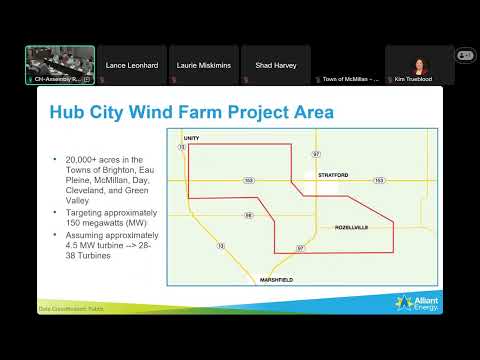
Alliant Energy told Marathon County’s advisory committee it is targeting about 150 MW for the Hub City Wind Farm, with roughly 28–38 turbines, a multi‑year permitting and construction timeline and financial and decommissioning protections to be filed with the Public Service Commission of Wisconsin.
Alliant Energy representatives briefed Marathon County’s Alternative Energy Project Local Impact Advisory Committee on the Hub City Wind Farm, describing project scope, timeline and local impacts. Ben Tanko, Alliant’s project manager, said the company has combined adjacent developments and is "targeting a 150 megawatts, plus or minus," with an illustrative turbine size of about 4.5 megawatts that would produce roughly 1,300–1,500 homes of annual electricity.
The company described outreach and site work that began in late 2022 and early 2023, including mailings, open houses and field micrositing. Tanko said the project currently involves about 20,000 acres and roughly 100 participating landowners. "We're still continuing leasing discussions," he said, and added that Alliant is "active right now, talking to folks, kinda trying to button things up" while environmental and cultural surveys continue this summer.
Why it matters: The scale of the Hub City plan will shape local road use, construction impacts, revenue distribution and long‑term land use. Tanko described Wisconsin’s state shared‑revenue program for generation, saying it is roughly $5,000 per megawatt and typically split so the hosting county receives about three fifths and towns about two fifths. He also estimated annual landowner lease payments at an approximately $11.8 million order of magnitude for the project, while noting this figure depends on final project size and contract terms.
Alliant outlined the regulatory path: additional field work and surveys in 2026, a regulatory submission to the Public Service Commission of Wisconsin (PSC) in late 2026, and a PSC review period that Tanko said now often runs 12–15 months. If permits are approved, construction would be expected in 2029. "If that decision is in approval, we'll already kind of be moving things along with turbine suppliers," Tanko said.
Tanko also addressed decommissioning and financial assurance. He said an independent engineering consultant prepares the decommissioning plan and cost estimate for the PSC filing and that the PSC requires financial surety so local governments will not be left with cleanup costs if a company becomes insolvent. "There are protections in place," he said, but added that the decommissioning plan and the salvage value of materials are factors in a net decommissioning cost calculation.
On construction and operations, Alliant explained foundations, collector cable installation and operations and maintenance needs. Tanko described wide, shallow foundations requiring significant concrete and said collector cables are typically trenched to about four feet or installed by directional drilling to avoid roads or wetlands. He said a project of this scale would typically include a small O&M building and "probably about 3 to 5 full time turbine technicians" on site, with continuous remote monitoring via supervisory control and data acquisition (SCADA).
Next steps: Alliant will continue leasing and surveys this summer and expects to return for future committee meetings to answer follow‑up questions and to provide updated materials. County staff asked the company to provide materials such as the presentation slides for committee and public distribution; staff also set a schedule for committee meetings, an open house and an online survey to collect public input ahead of a committee draft report due to the executive committee by July 13.