Get Full Government Meeting Transcripts, Videos, & Alerts Forever!
Get email alerts on the Signs And Ordinance topic
No spam. Unsubscribe anytime.
Committee briefed on emergency ordinance banning rebars and poles at wet-sand line, community workshop set for June 3
Summary
An emergency ordinance prohibiting rebars, poles and similar markers at the wet-sand/mean high water line was enacted after hotels placed hazardous rebars; the committee was briefed on the safety rationale and invited to attend a June 3 workshop to inform a permanent ordinance.
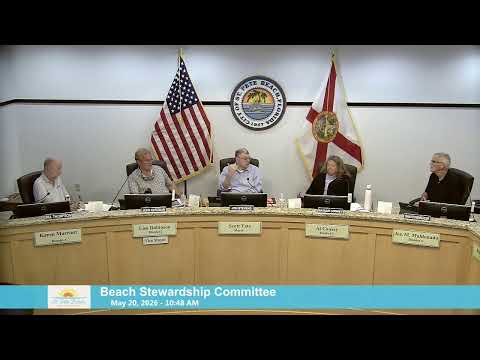
The city attorney told the Beach Stewardship Committee May 20 that the city adopted a short-term emergency ordinance banning rebars, posts and similar markers placed at or seaward of the wet-sand area after several hotels and property owners placed rods that posed a hazard to beachgoers.
The city attorney said the action followed reports of exposed rebars and other unipoles placed at what property owners believed was their mean high water line; staff and the sheriff's office met with affected property owners and most of the markers were removed during the seven‑day period provided by the emergency action. The city scheduled a public community workshop for June 3 at 6 p.m. in the same room to gather input before drafting a regular ordinance for first and second readings.
"We had an incident occur where one of the local hotels put a rebar into the wet sand area...and these rebars were just sticking out of the sand and were dangerous," the city attorney said, explaining the emergency step and the plan to use the workshop to consider options including a visible high‑water reference and definitions to close regulatory loopholes.
Members discussed legal complexities: whether to reference the mean high water line (a long-term tidal average) or a visible high‑water line, how riparian deeds and ownership to the water complicate a one‑size‑fits‑all ordinance, and how DEP and local sign/fence rules intersect. The attorney noted a DEP regulatory gap for single unipoles that the city hopes to address.
Committee members raised related concerns at the meeting: illegal mothballs placed in dune areas (a toxic hazard with federal penalties), chairs and cones used as de-facto private fences, and how BTR/business license fees currently treat chair rentals. Members encouraged the city to ensure the workshop includes property owners, wildlife advocates and enforcement agencies so the ordinance balances safety, customary use and private property claims.
Why it matters: The emergency ordinance addresses an immediate public-safety hazard and begins a public process to clarify how the city will distinguish public beach, private riparian rights and allowable markers in a way that protects people and coastal wildlife.
What comes next: The community workshop June 3 will be publicly noticed; the committee may attend and provide individual comments. Staff and the attorney will return with proposed ordinance language for formal readings based on community input.