Get Full Government Meeting Transcripts, Videos, & Alerts Forever!
Get email alerts on the Seawalls topic
No spam. Unsubscribe anytime.
Planning board reviews seawall-ordinance updates, debates 20% mitigation cap and appeals process
Summary
Building official Luke Curtis outlined proposed seawall-code revisions including five variance criteria, a proposed 20% cap on required stormwater mitigation relative to primary-structure value, a 4-foot NAVD administrative minimum, and a requirement that new construction have conforming seawalls. Board members pressed staff for data, code clarity, and a long-term resiliency plan to reach a 5-foot standard.
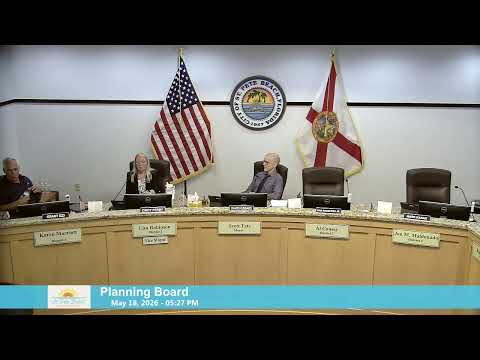
St. Pete Beach’s Planning Board spent the bulk of its May 18 meeting reviewing proposed updates to the city’s seawall ordinance and questioning how the changes would affect homeowners and the city’s resilience goals.
Luke Curtis, building official for the City of St. Pete Beach, explained the proposed language would clarify the five existing variance criteria in the code, streamline the administrative-variance process, and introduce measures intended to make future seawall upgrades easier (for example, designing seawall caps to accept later height upgrades). Curtis said the proposed criteria emphasize special conditions of upland property, non-financial hardship, risk to neighboring properties, whether hardship results from unwillingness to modify the site for required stormwater handling, and that any variance be the minimum necessary to mitigate peril.
A major focal point was a proposed threshold that would allow granting a hardship variance when the cost to implement required stormwater mitigation (not the seawall itself) exceeds 20% of the value of the primary structure. Curtis described the 20% number as a cap to identify when mitigation costs impose an excessive burden on the owner; several board members said they could not find the origin of that figure in code or guidance and asked staff to justify the threshold or propose alternatives.
Curtis also described proposed administrative-relief language that would set a minimum administrative elevation of 4 feet NAVD for relief and require that new construction bring its seawall into conformance. Board members raised concerns about whether recently constructed seawalls (for example, those two years old) would be forced to be replaced; staff repeatedly said triggers to force replacement are seawall disrepair or work done on the seawall itself, not ordinary home renovations.
Members asked for more data and clarity: how many seawalls exist, life-cycle estimates, neighborhood priorities for elevation work, and whether code sections referencing retention of a 25-year/24-hour storm (a 9.52-inch figure cited at the meeting) are consistent across the city code. Staff acknowledged apparent inconsistencies and recommended a broader code review and a resiliency plan that would set priorities and timelines for achieving a citywide 5-foot seawall standard rather than immediate, uniform mandates.
On appeals, staff described how administrative variances now lack a clear appeal path; the board discussed possible routes such as board of adjustment review or city council review and asked staff to propose an interim administrative appeal process while the code is modernized.
What’s next: Staff said it will return with clarifications, supporting references for the 20% threshold (or an alternative), and options for an appeals pathway and a longer-term resiliency plan; the board requested data on how many seawalls would need work to reach a 5-foot standard and an assessment of timeline and costs for prioritized areas.