Get Full Government Meeting Transcripts, Videos, & Alerts Forever!
Get email alerts on the Federal Policy And Evidence topic
No spam. Unsubscribe anytime.
Expert: Opportunity Zones 2 adds transparency and rural incentives but won’t guarantee investment
Summary
Kennan Fikry of the Economic Innovation Group said new Opportunity Zones rules increase reporting and add rural incentives, explained the three federal tax benefits for OZ investments and cautioned that designations do not guarantee capital will follow.
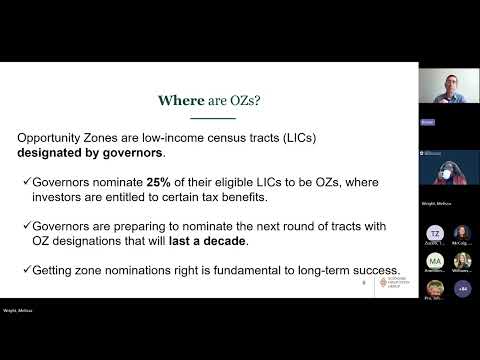
Kennan Fikry of the Economic Innovation Group told the webinar that Opportunity Zones remain a market-based federal tax incentive designed to change investor behavior but not to guarantee investment. "They are not guarantee zones," he said, noting the incentive aims to attract equity capital and often leverages debt, grants and public subsidies.
Fikry summarized the three principal federal tax benefits: deferral of capital gains tax when gains are placed into a Qualified Opportunity Fund for up to five years; a step-up in basis that reduces tax owed when the deferral ends (the transcript referenced historic 10% step-up and a larger, 30% step-up for rural investments under subsequent legislation); and a permanent exclusion on gains from eligible OZ investments held for at least 10 years.
He cited Treasury reporting that more than $100,000,000,000 in equity has been invested through Opportunity Zone incentives since enactment in late 2017, and that about three-quarters of tracts nominated in the first round saw some investment. Fikry said OZs have been particularly effective at catalyzing multifamily and mixed-use projects, adaptive reuse and historic rehabilitation when paired with other incentives, but that single-family-for-sale districts and many venture-style investments are poor matches for the statutory 10-year holding requirement.
Fikry acknowledged that OZ 1 suffered from limited transparency: the IRS collected data but there was no practical mechanism to make it public. He said new legislation will improve reporting so communities will be able to see which projects received OZ capital. He also said OZ 2’s enhanced rural incentives (including a larger basis step-up cited in the presentation) should make some rural investments more financeable, though rural deals have tended to be smaller in dollar size.
Fikry urged communities to apply three tests when selecting tracts: a community test (is public subsidy appropriate to help residents prosper?), a market test (is private capital likely to flow in the policy timeline?) and a policy test (are local policies, zoning and permitting investment-friendly?).