Get Full Government Meeting Transcripts, Videos, & Alerts Forever!
Get email alerts on the Local History topic
No spam. Unsubscribe anytime.
Talk traces "Kingdom of Happy Land," urges preservation; historical-marker application pending
Summary
A presenter recounted the history of the "Kingdom of Happy Land," describing archival research, artifacts and community ownership of land in the late 19th century, and said organizers have applied for an official historical marker; attendees asked about cemeteries and archaeology.
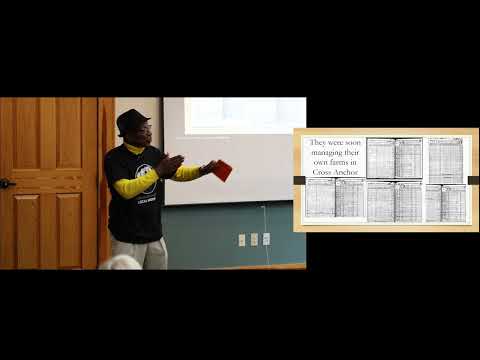
A presenter at a community event recounted the history of the "Kingdom of Happy Land," a Black landholding community formed after Reconstruction, and urged steps to preserve its physical and documentary record. The speaker said researchers pooled archival material online and applied for an official historical marker in December and are awaiting a decision.
The presenter described how a local Black-history committee found Sadie Patton's account of the community and won a grant from the Dogwood Trust to build a website and archive material at Blue Ridge Community College. "We got a grant from the Dogwood Trust, and we started a website called blackhistories.org," the presenter said, describing the group's effort to "archive all the stories of Black history." The presenter also said an archaeologist named Crystal conducted fieldwork and that artifacts and some court records are now held in a college archive and on the project's website.
Why it matters: The talk framed the Kingdom as an example of Black land ownership, mutual aid and self-governance during a period when violence and discriminatory labor contracts followed emancipation. The presenter emphasized that, contrary to some published accounts, many families in the community were skilled farmers, tradespeople and church leaders who organized to buy land and support one another. "They pooled their monies together," the presenter said, describing a purchase of land in 1882 that the talk identified as up to 200 acres.
The presenter highlighted threats and evidence gaps. Audience members asked whether cemeteries remain and whether structures survive; the presenter said a chimney is one of the few visible remnants and that the project has "put in an application to get a historical marker. We did that in December, and we're still waiting." The presenter also noted that some early newspaper accounts and rumors had painted the community in hostile terms — for example, calling members a "cult" — but said the archival record and oral histories tell a different story. "We have to search for the truth," the presenter said.
Details and sources: The presenter repeatedly cited Sadie Patton's account and related local sources (Blue Ridge Community College archive) and said that the project's website contains court cases and other documentation. The talk mentioned the Palmetto Trail as a geographic reference for visitors and named Mud Creek Missionary Baptist Church and Saint John's of the Wilderness in Flat Rock as repositories of memory. The presenter said the community used the Buncombe County turnpike for market travel and noted work at the Zirconia mine and on regional rail lines as economic drivers that later changed local livelihoods.
Next steps: Organizers are awaiting the historical-marker decision and continue to collect oral histories, digitize records and pursue archaeological work. The presenter urged attendees to document family histories and church records and to support local efforts to mark and interpret the Kingdom's sites.
The presentation closed after audience questions about markers, gravesites and remaining structures; the presenter apologized for running over time.