Get Full Government Meeting Transcripts, Videos, & Alerts Forever!
Get email alerts on the Education Programs topic
No spam. Unsubscribe anytime.
Students and staff at Mary Frank highlight community service, literacy gains and inclusive programs
Summary
At a PHM board meeting at Mary Frank Elementary, students showcased the Mustangs Give Back community service projects, principal Christy Hirschoff and interventionist Laura Khalil outlined literacy 'win time' gains for K–5, and Penn High School representatives described Exceptional Education and Freshman Academy inclusion efforts.
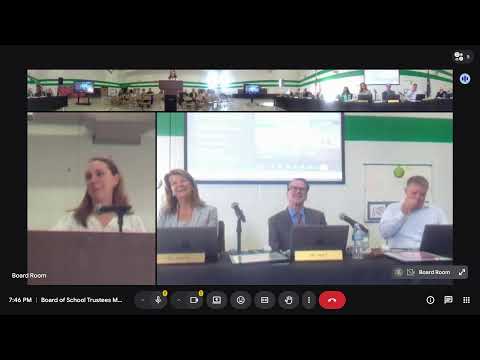
Visiting Mary Frank Elementary for its site meeting, the Penn‑Harris‑Madison Board of School Trustees heard student newscasters and members of the Mustangs Give Back Club describe year‑long service projects and the school’s community connections.
Students recounted a November food drive that collected more than 1,100 pounds for the Mishawaka food pantry, a senior‑living visit with activities and gifts, and a spring donation to the Potawatomi Zoo. Principal Christy Hirschoff emphasized the school’s literacy focus and introduced Laura Khalil, the building interventionist, who explained the school’s "win time" (What I Need) model: a 40‑minute, data‑driven block during which teachers, interventionists and aides deliver targeted, research‑based interventions and monitor progress via DIBELS and RTI processes.
Khalil described measurable progress in early grades: a cohort of second‑grade students that began the year with 36.7 percent below benchmark showed average to well‑above average growth for 95 percent of that subgroup by midyear, leading to nearly a 10 percentage point reduction in students below grade level. Khalil noted iRead results for the most recent year had not yet been published but said the district’s prior results were strong.
At Penn High School, leaders described expansion of co‑teaching and inclusion in electives and introduced peer leadership, AAC (augmentative and alternative communication) supports and assistive‑technology training to normalize use of speech‑generating devices. Peer leaders and multiple freshmen described the Freshman Academy model of houses and shared core teachers, and students credited the program with helping them build belonging and navigate a large high school.
The presentations were informational; board members praised the programs and students. No votes were required for these informational items.