Get Full Government Meeting Transcripts, Videos, & Alerts Forever!
Get email alerts on the Short Term Rentals topic
No spam. Unsubscribe anytime.
Charlottesville staff recommend keeping homestay ordinance, step up enforcement and monitoring
Summary
Neighborhood Development Services recommended maintaining the city's current homestay ordinance while strengthening proactive enforcement using Granicus software, staff outreach and public education; staff cautioned that a recent state law change allowing renters to operate short-term rentals with landlord permission could have unknown impacts if the city changes its code.
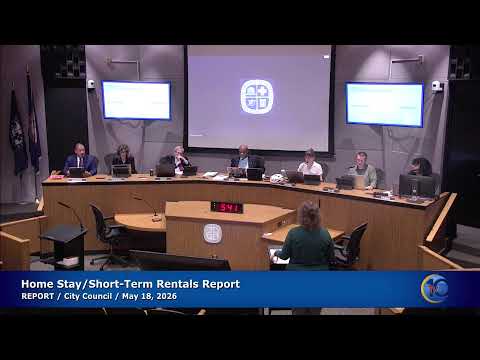
Missy Creasy of Charlottesville’s Neighborhood Development Services briefed the council on May 18 on a year-long homestay and short-term rental (STR) study and recommended keeping the current homestay ordinance while expanding enforcement and monitoring.
Creasy said staff researched other jurisdictions, reviewed state code changes and used a new Granicus software tool to locate listings, catalog rental histories across platforms and support proactive enforcement and tax compliance. The city’s current rules require owners to reside at a property at least 185 days per year to obtain a homestay permit; permits are valid for one year, carry a $100 fee, and include safety requirements.
Staff summarized community engagement—an online survey of about 500 respondents, targeted outreach and a December 2025 public meeting—and said many residents support homestays when paired with stronger enforcement. Creasy told council that outreach notices and reminders produced roughly 84 permit applications after the department’s mailing wave to previously unpermitted operators.
A new Virginia law was a focus of the study: if the city changes the homestay code it would be required to allow renters to operate short-term rentals with landlord permission, which could increase the number of operators; staff advised caution and suggested monitoring other Virginia localities that implement similar code changes before taking action. Creasy also noted a state requirement for human-trafficking awareness training for STR operators, administered at the state level.
Councilors asked about Granicus data limits (for example, whether the system distinguishes ADUs from whole-house rentals), enforcement capacity, complaint follow-up, and investor ownership of multiple listings. Missy Creasy said Granicus improves identification of listings but does not always indicate whether a property contains multiple units; staff will analyze records further. Enforcement options include warning letters, fines and potential court action, and staff will consult the city attorney’s office on the best path for complex cases.
Planning commission feedback supported maintaining existing regulation and increasing enforcement, with suggestions to let building codes determine maximum occupancy and to keep the permit timeframe under review. Staff recommended tracking impacts and revisiting the code if other jurisdictions’ experience shows significant unintended consequences.
Next steps: continue proactive outreach and enforcement (warning letters followed by escalation where necessary), expand public education, refine data on ADUs and unit counts, and monitor state-level changes and other cities’ approaches before proposing code revisions.