Get Full Government Meeting Transcripts, Videos, & Alerts Forever!
Get email alerts on the Vector Control topic
No spam. Unsubscribe anytime.
Metropolitan Mosquito Control District warns of elevated West Nile risk and expands surveillance in Minnetrista
Summary
At the May 18 Minnetrista City Council meeting, MMCD officials described a record 2025 West Nile year, outlined surveillance and larval-control strategies, warned of a likely midsummer mosquito surge and urged residents to heed tick-checks; the district also described drone/helicopter larval treatments and no widespread tick spraying.
Alex Carlson, public affairs manager for the Metropolitan Mosquito Control District, told the Minnetrista City Council on May 18 that 2025 was a record West Nile year and that the district is expanding its surveillance and testing capacity.
"Last year we saw 50 human cases, which smashed our previous record of 28," Carlson said, citing a high mosquito infection rate from the districts samples. He said the districts lab currently tests for West Nile virus and is renovating its Saint Paul lab to expand PCR testing next year.
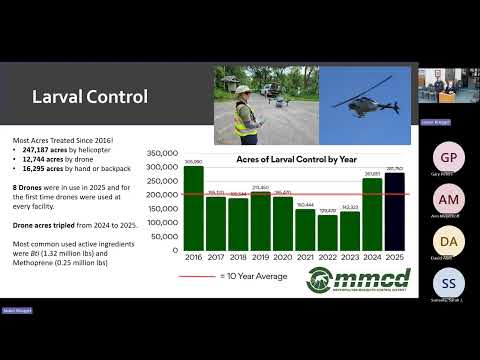
The MMCD emphasized larval control as the preferred approach. Carlson said the districts primary tools are larval treatments placed in standing water (bacterial-based granules such as BTI), targeted adult control only when disease is detected, and source reduction to eliminate breeding habitat. He said these larval-control products activate only in standing water and have minimal non-target impacts.
Ben Lubeck, a MMCD field supervisor who covers the Minnetrista area, described local operations: the district inspected more than 100 sites, treated approximately 2 acres of adult mosquitoes and handled hundreds of catch-basins and tire-recycling events. He advised residents to sign up for interactive maps and helicopter-alert e-mails so they can see where the district plans control activities.
Council members asked whether pellets dropped from helicopters and drones are safe for people. Carlson said the commonly used active ingredient is BTI, a general-use product Americans can buy at retail stores, and that direct contact poses no known human-health risk. He asked residents to report any direct encounters so the district can coordinate with pilots.
On ticks, Carlson said MMCD conducts tick surveillance and public education but does not perform large-scale tick spraying because of the ecology of tick habitat; he urged residents to perform regular tick checks and pet preventatives.
The presentation closed with a public-outreach reminder about tire-collection events (up to 10 tires per household at no charge) and safety-camp and parade participation offers to cities.
Council thanked the presenters and noted the district will likely increase targeted activity this summer if weather and early-year surveillance indicate elevated risk.