Get Full Government Meeting Transcripts, Videos, & Alerts Forever!
Get email alerts on the Juv Detention Reopening topic
No spam. Unsubscribe anytime.
Henry County commissioners review feasibility of reopening youth detention center, debate private operator Abraxas and funding
Summary
At a work session commissioners reviewed a Baker Tilly feasibility report on reopening the county's vacant youth detention center, discussed leasing the facility to private operator Abraxas versus county operation, examined capacity and cost scenarios, and directed staff to draft lease/RFP terms; no formal vote was taken.
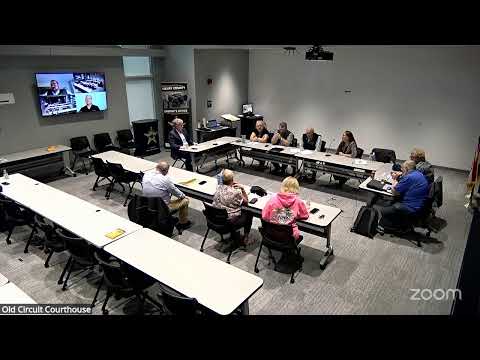
Henry County commissioners and council met in a work session to review a Baker Tilly feasibility study on reopening the county's vacant youth detention center and to consider whether a private operator should run the facility or the county should reopen and operate it itself.
A presenter summarized the report and the financial scenarios Andy modeled: at 80% occupancy the facility would generate a modest annual net of about $124,500; at 95% occupancy the model showed roughly $890,500 in net revenue; but at 50% occupancy the county would face a net loss of about $1,518,500. "What we really need to understand is what capacity we could expect to run at," the presenter said, and turned the discussion to utilization assumptions.
Susan Lightfoot, who reviewed utilization and spoke with operators in other counties, said smaller detention pods often run well under capacity because of segregation and staffing rules. She described examples in which some pods operated with only one or two youths on many days, and said those operational constraints make it difficult for a small local facility to approach the higher utilization levels in the report.
Commissioners discussed the prior proposal from private operator Abraxas. Multiple participants said the Abraxas proposal would have shifted occupancy risk to the company but at higher total cost — the county was told outsourcing could be roughly 40% more expensive overall, even though Abraxas would assume bed‑filling risk. Several commissioners said Abraxas had used a higher per‑diem figure in earlier talks (participants cited $600–$700 per bed per night as the figure that stalled negotiations), which county leaders called "sticker shock." One commissioner said leasing the facility to a private operator that assumes occupancy risk could be preferable to the county funding any shortfall directly.
The meeting also reviewed other revenue and cost lines that affect feasibility. Commissioners and staff discussed state reimbursements: speakers cited DCS emergency shelter care per‑diems and a reported $113.47 figure for some DCS reimbursements, and said the state could pay up to $2,000 per night for certain emergency beds in the first year but would expect documented costs thereafter. County staff emphasized that those state payments are limited and that emergency shelter revenue alone could not be expected to subsidize a full secure detention operation.
Participants reviewed renovation and upkeep estimates for the unused building. Estimates discussed during the meeting ranged broadly — speakers cited figures from about $900,000 up to $2,000,000 — with several saying a midpoint near $1 million to $1.5 million was plausible depending on the scope. Operations staff described ongoing fixed costs while the building sits vacant (examples included water bills of $600–$1,000 a month for sprinkler systems and recent large boiler and furnace repairs). "Whether it's being utilized or not, it's costing us money," a facilities staff member said.
On budget implications, commissioners and an auditor's‑office presenter noted county constraints. The county currently budgets $250,000 a year for secure beds and spent about $122,470 last year; through early May the county had spent roughly $29,235 on secure beds. One finance speaker flagged limited tax headroom and recent state changes labeled in the session as "SEA 1," saying that those changes reduce the county's ability to raise revenue to cover a large ongoing subsidy.
Rather than a firm decision, the meeting produced a path forward. Commissioners agreed they need to prepare short, clear lease terms or an RFP one‑pager and identify private operators to solicit competitive proposals. "If we can move forward with Abraxas or another company, take the upfront money stuff out of the equation, and let them negotiate with other counties for whatever cost per bed there is, then the risk's on them, not on us," one commissioner said. Staff and commissioners proposed a small pre‑meeting to draft lease terms and aimed to have proposals or draft lease language available before budget time in late July. Because the gathering was a work session, no motion or formal vote was taken.
Next procedural steps identified by the group: draft lease terms (including whether counties may resell reserved beds), assemble a one‑page RFP or set of expectations commissioners want to include, identify two or three potential private providers for competition, and clarify the specific capital work that DOC or DCS would require for secure and shelter licensing. Commissioners asked staff to return with a concrete lease draft and cost estimates before budget decisions.
The meeting closed with agreement to continue the conversation; participants thanked each other and no formal action was recorded.