Get Full Government Meeting Transcripts, Videos, & Alerts Forever!
Get email alerts on the Short Term Rentals topic
No spam. Unsubscribe anytime.
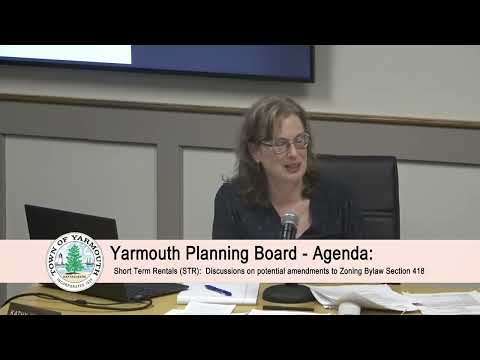
Yarmouth planning board debates major short‑term rental bylaw changes, sets May 27 comment deadline
Summary
Planners reviewed UMass Donahue study findings and a draft redline of §4.18; discussion focused on whether to remove or extend a sunset clause, enforceability of an operator contact rule, parking/occupancy limits, ownership caps, and whether to adopt a general bylaw instead of zoning. Board members asked for comments to Planner Cathy Williams by May 27.
Town Planner Cathy Williams told the Planning Board on May 20 that the UMass Donahue study and local data indicate short‑term rentals make up roughly 5–8% of Yarmouth’s housing stock and “really don’t appear as though short term rentals are having a significant impact on year round housing in our housing market.” She recommended several administrative and regulatory steps, including registering short‑term rentals with 24‑hour contact information, posting inspection/rental certificates visibly on units, and coordinating police with building/health departments for off‑hours enforcement.
Board members extensively debated the policy tradeoffs. Several members supported retaining or extending a sunset clause to preserve flexibility as the lodging market evolves; others questioned whether a sunset simply postpones a tougher choice. One member summarized the legal constraint: attorney general guidance and state law complicate efforts to completely prohibit grandfathering once a use exists in zoning.
Parking and occupancy were raised repeatedly as practical enforcement levers. Planner Williams highlighted Falmouth’s approach — requiring a parking plan and occupancy caps tied to bedroom counts — and suggested a posted one‑page guidance sheet for renters listing quiet hours, trash rules, parking instructions and the 24‑hour contact. The board discussed using fees, seasonal intern staff, or reassigning duties to manage registration and inspections.
Members also debated owner and operator rules. Draft language in the Falmouth example would limit an owner to three licenses and require an operator contact within 20 miles; board members questioned enforceability and whether corporate operators could sidestep restrictions by using management companies. Provincetown and Falmouth bylaws were cited as models and contrasts.
The board asked members to send comments to Planner Cathy Williams by next Wednesday, May 27, so she can prepare Draft 2. Chair Joanne Crowley emphasized a preference for balancing neighborhood protections, enforcement practicality, and retaining the town’s tourism tax revenue stream.
Next steps: staff will incorporate common comments into a second draft, the board will consider public engagement and a possible hearing, and the select board will be kept informed as the process proceeds.