Get Full Government Meeting Transcripts, Videos, & Alerts Forever!
Get email alerts on the Data Center topic
No spam. Unsubscribe anytime.
Sunbury residents pressed council to restrict proposed Amazon data center over water, noise and secrecy concerns
Summary
Residents at the May 20 Sunbury City Council meeting urged officials to block or tightly regulate a proposed Amazon/AWS data-center campus — citing water use, power demands, diesel-generator emissions, noise and 24-hour lighting — and called for public monitoring, stronger local ordinances and transparency around NDAs and permitting.
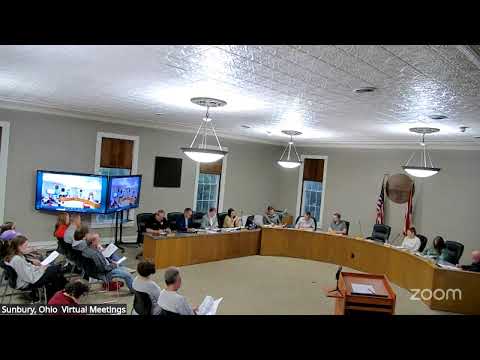
Dozens of Sunbury residents used the council’s public-comment period on May 20 to urge city officials to block or strictly limit a proposed data-center campus near residential neighborhoods, citing large water and power demands, air and noise pollution, around-the-clock security lighting and secrecy around project details.
“Please require continuous, publicly available acoustic monitoring to ensure that data centers and construction equipment do not exceed local limits, especially at nighttime,” said Nicole Shipley, a Miller Farm resident, asking the council to negotiate a community benefits agreement with the developer and to require published logs showing how often backup diesel generators are tested and run.
Multiple speakers described technical and environmental concerns. Joe Fuller, who said he works in and near data centers, warned of health and noise risks and cited what he called high usage figures, saying in part: “These diesel generators … are used daily, a 100% … 9,000 gallons of diesel fuel per generator.” Christine Gelman cited a hydrology figure she reported as 2.5 million gallons per day and said a facility the size announced for phase 1 (she quoted a 450,000-square-foot footprint) could use between about 100 and 450 megawatts depending on buildout — far more than Sunbury’s household power needs.
Residents emphasized impacts beyond technical metrics. Holly Park said the project would change the village’s rural character and dark skies because data centers require continuous mechanical systems and 24-hour security lighting. Rena Carver, a long-time resident, posted a map she said shows data-center impacts can extend several miles and told the council that Big Walnut schools and much of Sunbury fall inside the circle she drew.
Several speakers voiced frustration with secrecy and the information flow. Patty Shipley and Katrina Sontag said they had been gathering petition signatures and raised alarms about NDAs and opaque early-stage project disclosures; Sontag also linked the data center to a third-party surveillance product she described as connected to data-center storage. Theresa Parker directly challenged the council for not stating where they stand on the project and asked officials to publicly clarify their positions.
City Manager (addressing the council later in the meeting) said the Ohio General Assembly had formed a bipartisan joint legislative committee to collect testimony on data-center economic, environmental and security impacts and that hearings were scheduled to begin in late May; he also noted House Bill 646 — a separate study commission bill — remains pending in the Senate. The manager said the state-level process aims to provide local officials with more information they can use during local decision-making.
What’s next: residents urged the council to adopt enforceable local measures — such as community benefits agreements, required public monitoring and lighting and noise ordinances — and to post more project information for the public. The city manager pointed residents to the upcoming state hearings as one source of additional information; no formal action on the data-center project was taken at the May 20 meeting.
Provenance: This article draws from public comments and the city manager’s report during the May 20 meeting (public-comment thread beginning with Nicole Shipley and closing with Rena Carver, and the city manager’s update on the joint legislative committee).