Get Full Government Meeting Transcripts, Videos, & Alerts Forever!
Get email alerts on the Infrastructure topic
No spam. Unsubscribe anytime.
Falmouth outlines Great Pond Phase 1 sewer project, schedule and homeowner costs
Summary
Town of Falmouth wastewater staff said construction began in April on the Great Pond Phase 1 sewer project and is contractually due to finish by the end of 2027; sewer connections should be available late 2027 or early 2028. The town estimates a $49.65 million project with about $14.74 million to be assessed to properties (roughly $17,379 per sewer-equivalent unit, preliminary).
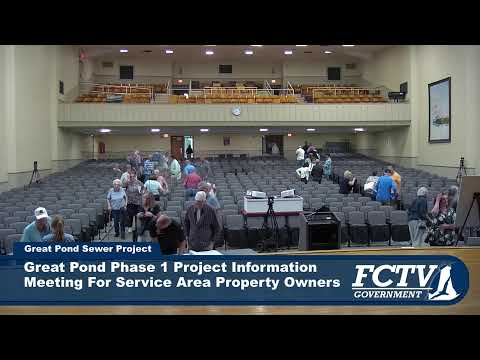
Amy Lowell, the Town of Falmouth’s wastewater superintendent, laid out details of the Great Pond Phase 1 sewer project at a public presentation, including scope, schedule, financing and how homeowner costs will be assessed.
Lowell said the project will install new collection mains in the service area, build a lift station on Brick Kiln Road and install force mains to the treatment plant. Construction contracts were executed in February, work began in April and the contract calls for substantial completion by the end of 2027; Lowell said sewer service for property connections should be available in late 2027 or early 2028 and "property owners will have a year to connect to the sewer after notification to connect."
Why it matters: the project covers roughly 799 parcels in the service area and is aimed at reducing nitrogen and improving water quality in Great Pond. The financing plan allocates part of the project cost to the service area as a betterment assessment and leaves the remainder to be paid by the town. That allocation determines how much individual property owners may pay and how the cost appears on tax bills.
Project cost and financing Lowell reported an updated total project cost of $49,650,000, about $10 million below earlier estimates largely because the collection-system bid came in significantly lower than the engineers’ estimate. She said roughly 25% of State Revolving Fund (SRF)-eligible costs will be forgiven, and after accounting for loan terms and forgiveness the town’s net project cost is about $39.33 million. The portion to be covered by betterment assessments is currently estimated at about $14.74 million.
The betterments were allocated by sewer-equivalent units (SEUs): staff assigned 848.25 SEUs across the service area, and Lowell said the initial per-SEU betterment estimate is about $17,379. Betterments may be paid over 30 years at 0% interest; Lowell illustrated that a 30-year payment plan would equal about $579 per year for one SEU. She emphasized these numbers are preliminary: the select board must vote an order of assessment, final certification of project costs will occur after construction is complete, and assessments could only go down (not up) after final accounting.
How homeowners connect and rule changes Lowell explained the service area includes gravity-fed streets and areas served by low-pressure systems that require grinder pumps at individual properties. For earlier Little Pond work the town installed grinder pumps for single-family homes and provided maintenance; the town is proposing a similar policy for this project but said it must first secure legislative authorization to expend municipal funds on equipment installed on private property. Lowell said the town has petitioned the legislature for that authorization and expects it to clear procedural steps in the near term.
She also proposed changing the town bylaw (via a town-meeting article) to allow licensed sewer installers (board-of-health licensed septic installers) to perform the outside connection work rather than requiring a licensed plumber for every job; installers who will work on grinder pumps would need documented pump training and insurance.
Permitting and assistance Permits will be managed with the town’s permit system (PermaDize); contractors generally will file permits rather than individual homeowners. Lowell listed potential assistance options: the town obtained a 0% SRF loan and SRF forgiveness that reduce costs, the Cape Cod Aqua Fund offers low-interest connection loans to qualifying applicants, and Massachusetts tax credits are available that may cover a portion (Lowell said state credits can cover up to 60% of connection cost, subject to caps and eligibility). She cautioned that connection costs vary widely by site conditions and recommended property owners obtain multiple contractor quotes.
Public questions and equity concerns Residents asked about condo buildings and multi-owner units. Lowell said the select-board policy assigns one SEU per residential unit (single-family and condo units), but noted in some cases—such as the Falmouth Port condominium association—unit owners expect the condo association to coordinate and pay for connections, which can reduce per-owner connection costs. She pointed to precedent from prior projects where final connection costs fell below early estimates because contingency funds were unused.
Operational and resilience issues On power outages, Lowell said homeowners with backup generators that power a grinder pump would be unaffected; for homes without a generator she advised conserving water during outages because grinder-pump tanks have limited storage. She also described a limited town 'pump-down' service in past projects (one pump-down per property per day when accessible) and said the town would revisit that service policy with the select board.
Next steps and process milestones The select board has not yet voted the order of assessment. Lowell said property owners will receive certified-mail notice before a select-board hearing on the assessment; after a vote and recording the collector’s office will send final assessment notices and the amounts will be added to property tax bills (anticipated to first appear in tax bills in 2028). The lift station and force-main construction and paving work are on the contractor schedule; staff will provide weekly construction updates on the town website and a project PDF of the presentation will be posted.
Community reactions and local guidance Residents at the meeting raised practical questions about electrical requirements for grinder pumps, the fairness of SEU assignment for multi-unit buildings, and whether additional grants are available. Ed Jalowick of the Water Quality Management Committee urged owners to get multiple quotes and to consult a plumber early; he said his own connection bids varied widely depending on site conditions.
The select board must still vote the betterment order and any grinder-pump subsidy or purchase decision; the town also awaits legislative authorization before approving a town-funded pump program for private property. Staff said they will post answers to outstanding technical questions and provide one-on-one consultations for property owners after the session.