Get Full Government Meeting Transcripts, Videos, & Alerts Forever!
Get email alerts on the Wildfire Preparedness topic
No spam. Unsubscribe anytime.
Carbondale officials warn of elevated wildfire risk, outline mitigation, home-hardening and evacuation steps
Summary
At a public forum in Carbondale, fire officials and the Wildfire Collaborative outlined a drier, warmer seasonal outlook, urged home hardening and sign-ups for alerts, described large fuels projects and presented parcel-level modeling that officials say guides where mitigation dollars should go.
At a town forum in Carbondale, fire officials and the Wildfire Collaborative told residents that an unusually warm, dry outlook raises the potential for large wildfires in the coming months and laid out mitigation, evacuation and preparedness steps.
"Lower than normal precipitation, warmer than normal temperatures, and a higher potential for large wildfires," the fire chief said, summarizing seasonal projections and urging residents to prepare now. The chief emphasized regional coordination among local departments and the importance of individual readiness — including go bags and signing up for emergency alerts.
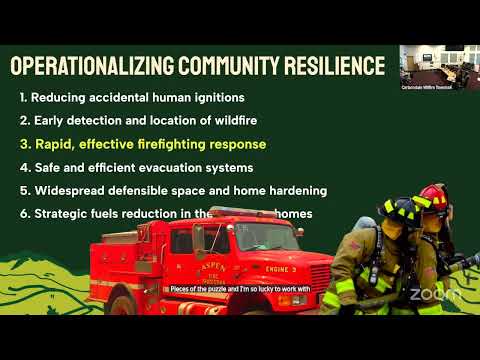
Angie Davlin, executive director of the Wildfire Collaborative Roan Fork Valley, described a suite of community-resilience actions: rapid detection through valley-wide Pano AI camera systems, strategic fuels reduction and widespread defensible-space and home-hardening work. "We are going to work on proactively reducing the destructive consequences of fire," Davlin said, and she recommended free, confidential home risk assessments offered by Carbondale Fire to identify practical, property-specific mitigation steps.
Davlin also discussed a partnership with Vanderbilt University to run building- and parcel-level fire-behavior simulations. She presented model-based results from a Snowmass-area scenario: reducing projected home losses in that model by roughly half would cost about $5 million in targeted mitigation, and a more extensive $25 million program was presented as a modeled pathway to near‑zero modeled home losses in the scenario she described. Davlin attributed those dollar figures to the modeling work and framed them as planning estimates rather than guarantees.
Carl Oliver, Carbondale Fire marshal, described how the district’s free home-risk assessments work and noted that Colorado’s wildfire-resiliency code (cited in the presentation as taking effect July 1) will affect certain new construction and modifications; plan review and permitting will be used to evaluate storage-battery and other code-related risks.
Brandon Dieter, division chief of the newly formed wildland fire division, said the department has expanded initial-attack patrols and hired seasonal staff to run two patrol trucks during the season. He said those patrols, combined with interagency aircraft and federal resources, improve initial response but do not remove the need for pre-event mitigation and resident preparedness.
In a Q&A, officials addressed common resident concerns: large-animal evacuation staging (county emergency operations centers and fairgrounds were cited as options), the limits of fighting lithium-ion battery fires, and use of drones (useful for mapping but constrained near federal air operations). Presenters encouraged neighborhood- or HOA-level organization (Firewise programs), use of county chipping resources where available, and incremental home-hardening projects — "chip away at it," the fire chief said — so homeowners can make progress without assuming unrealistic one‑time projects.
Officials closed by urging residents to sign up for county alerts and the ReachWell app channel, take a free home assessment and begin simple mitigation steps this summer; they reiterated that modeling and fuels projects are tools to target limited funding, not substitutes for household preparedness.