Get email alerts on the Data Center Moratorium topic
No spam. Unsubscribe anytime.
Seattle committee debates moratorium on large data centers; staff cites 20‑MVA threshold proposal
Summary
Committee members heard extensive public comment urging a pause on large data‑center projects and discussed technical scoping for a proposed moratorium (CB 121214). Central staff described a proposed threshold aligned with recent state proposals; no committee vote was taken and members asked for a work plan and more definitional clarity.
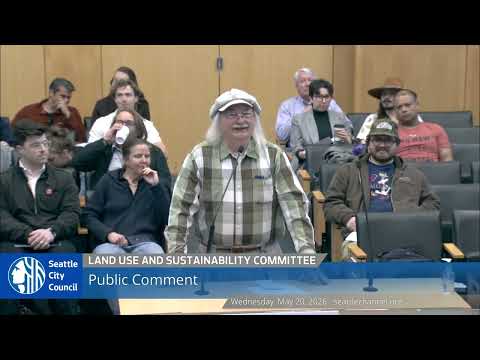
The Land Use and Sustainability Committee held a briefing on May 20 about a proposed moratorium on large data centers (CB 121214), hearing sustained public comment on energy, water and equity impacts and asking central staff for clearer technical definitions and a work plan. No vote was taken; members said the moratorium and an associated resolution would return for further committee consideration.
Central staff member Eric McConaghy said the moratorium is intended to pause new applications for large standalone data centers while the city studies environmental, infrastructure and community impacts. Staff described using a threshold that tracks a 20‑megawatt (MVA) definition—language that has appeared in state‑level proposals and other jurisdictions—to distinguish very large, AI‑scale facilities from smaller, co‑located or city‑critical uses. "We largely adopted what was originally a 20‑megawatt definition... we needed something quickly for the moratorium," McConaghy said.
Public commenters urged the pause and pressed the council to study electricity pricing, water use and local impacts. Audrey Wong Gosnell, an electrical engineer and sustainability specialist, told the committee that Seattle’s power grid and freshwater resources are already strained and that data centers could raise energy prices and divert freshwater for cooling. Food and Water Watch’s Thomas Meyer cited a national estimate that U.S. data centers could use up to 720,000,000,000 gallons of water annually for cooling, a figure he presented as rationale for a moratorium.
Committee members asked staff to clarify how the moratorium would be scoped—what size and kinds of facilities it would cover—and whether essential, city‑critical facilities and small on‑site server rooms would be exempted. Members also discussed the potential for mitigation measures such as utility rate structures or community benefits but emphasized the need for technical analysis before setting permanent rules. Council President Hollingsworth described the moratorium as a one‑year pause to assess impacts and policy choices, if the ordinance moves forward.
Next steps: staff said they will refine definitions and return with a work plan; the committee scheduled further consideration at upcoming meetings. The moratorium was presented as an interim tool to allow coordinated study with City Light and other departments and to develop permanent regulations if warranted.
AI generated
The text on this page is AI generated. Summaries, highlights, analysis, and video transcripts are all produced from the original source material.
AI can make mistakes, so if you spot one, and we will fix it for everyone.
Note: the source content is unaltered by us. Any content source we link to, be it a video, an audio recording, or a document, is presented exactly as its publisher released it. That publisher is usually a government body, sometimes an individual official or another organisation.