Get Full Government Meeting Transcripts, Videos, & Alerts Forever!
Get email alerts on the Housing Opportunities topic
No spam. Unsubscribe anytime.
Seattle committee recommends housing-opportunities bill after public hearing; outreach and appeals draw sustained concern
Summary
The Land Use and Sustainability Committee voted to recommend passage of Council Bill 121196 (Housing Opportunities Package) to the full council, 4‑0 with one abstention, after a lengthy public hearing that included supporters urging faster housing production and opponents demanding more outreach and equity analysis.
The Seattle Land Use and Sustainability Committee on May 20 recommended that the full City Council pass Council Bill 121196, known as the Housing Opportunities Package, after a public hearing and committee discussion. The committee recommendation passed with four votes in favor and one abstention and will be transmitted to the June 2, 2026 City Council meeting for final action.
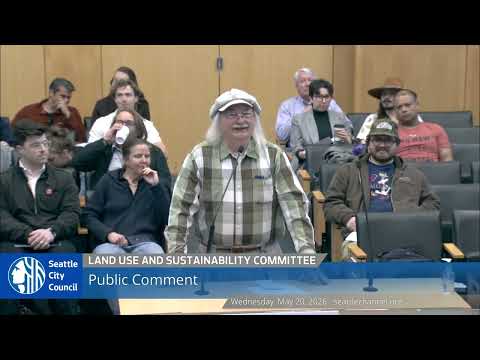
Supporters at the two‑hour public hearing said the package would unlock targeted up‑zones and encourage building types—such as mass timber, passive house and modular construction—that could speed housing delivery near transit and neighborhood services. "This is where we want housing," said Ian Moore, who identified himself as supporting the bill and urged the committee to move it forward to create more housing options across the city.
Opponents and some community groups urged the council to pause or modify the bill until more outreach is completed and neighborhood impacts are analyzed. Multiple commenters criticized what they described as insufficient public engagement and urged racial‑equity reviews, tree‑canopy protections and anti‑displacement safeguards before rezones occur. "Please require a racial equity toolkit analysis and a senior and fixed‑income impact assessment for each affected neighborhood," one commenter said.
Committee members acknowledged competing goals. Council President Hollingsworth said she supported the bill but abstained on the committee recommendation to allow additional outreach with community partners in the Madison‑Miller area and to double‑check that local institutions had been consulted. Chair Eddy Lynn moved to suspend the standard timing rules so the committee could vote; the motion was seconded and the committee recorded four votes in favor, zero opposed and one abstention.
The bill would rezone parcels in several neighborhoods, including the University District, Fremont, Madison‑Miller and Rainier Beach, amend development standards to enable more housing and provide incentives for community‑serving uses and higher‑efficiency building methods. Central staff said the proposal also seeks to remove code barriers to passive‑house and mass‑timber construction and to allow conversion of commercial space to housing in more zones.
The committee discussion highlighted procedural and local‑engagement concerns raised repeatedly during public comment. Several residents and environmental groups urged more robust notice, direct outreach, and neighborhood‑level impact studies before council finalizes upzones. Council members said they would continue to work with city departments and community stakeholders as the measure moves to full council.
What happens next: the committee’s recommendation and the bill will be placed on the June 2, 2026 City Council agenda for final consideration. Committee members said they expect continued public engagement and additional opportunities for amendments at the full council stage.