Get Full Government Meeting Transcripts, Videos, & Alerts Forever!
Get email alerts on the Work Plan topic
No spam. Unsubscribe anytime.
Encinitas council reviews FY 2026–27 work plan, asks staff for SMART objectives and follow‑up
Summary
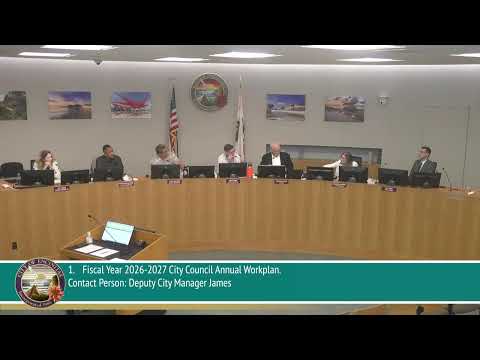
At a special meeting the Encinitas City Council reviewed a draft FY 2026–27 work plan with six focus areas and 35 goals, asked staff to refine objectives into specific, measurable targets and scheduled a follow‑up to align the plan with the budget.
Mayor Ehlers convened a special meeting of the Encinitas City Council to review the proposed FY 2026–27 work plan, identify needed refinements and give staff direction before the budget cycle. Deputy City Manager James presented the draft and said, “As an overall summary, there are 6 focus areas and as presented currently, with 35 goals.”
Council members and staff discussed three categories of staff attention: amendments already made to the draft, fiscal or staffing implications that may require extra resources, and goals staff proposes to remove or consolidate into existing programs. Staff pointed to items it had already embedded into other efforts — for example, some public‑safety financing work was suggested to move into the five‑year Capital Improvement Program (CIP) instead of remain as a separate long‑term financial plan. The draft also adds work on a dark‑sky ordinance and a study of inclusionary housing allocation.
Members pressed staff to translate broad goals into SMART objectives — specific, measurable, achievable, realizable and trackable targets — that can feed the budget. Ehlers said the council should be clear about who will do the work and when, then recommended a follow‑up meeting: “we re —ew ays—rom—udget doption nd re ctually sking—or —it —it—xtra ttention,” and later suggested coming back on June 17 for more detailed measurable objectives.
Council and staff discussed specific reassignments: staff proposed moving the pavement rehabilitation program into the CIP so design and construction phases are tracked across years; it recommended folding a proposed safe‑streets action plan into the larger circulation element update, and carrying forward several ongoing projects (fire station work, the homeless action plan, and the economic development strategic plan) from the current work plan. Development services staff cautioned that drafting an historic‑resources ordinance requires an inventory, significant outreach and policy choices about restrictions versus incentives and may take longer than a single work plan year.
Staff flagged that some objectives — traffic safety outreach, e‑bike safety programs, expansion of the Habitat Stewardship Program and a marketing plan for the business commission — may require additional fiscal or staffing support and said the council could budget for consultant or staffing help to accelerate those efforts. Council members noted existing budget flexibility, potential FEMA reimbursements and the option of midyear amendments if funding cannot be found immediately.
The council did not take a formal vote at the meeting. Next steps: staff will return with revised, measurable objectives and cost estimates; the council signaled support for a follow‑up session to finalize objectives and align the work plan with the FY 2026–27 budget timeline.