Get Full Government Meeting Transcripts, Videos, & Alerts Forever!
Get email alerts on the Open Space Policy topic
No spam. Unsubscribe anytime.
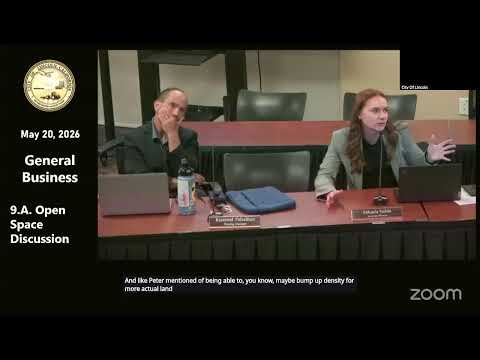
City manager asks planning commission for input on open-space guidance and incentives
Summary
City Manager Sean Scully presented options May 20 to clarify how Lincoln applies the general-plan 40% open-space guidance and whether to offer incentives (connectivity, active amenities, density trades) to encourage higher-quality open space, while developers and designers urged flexibility and design-driven solutions.
City Manager Sean Scully asked the Planning Commission on May 20 for feedback on potential changes to how Lincoln treats open space in development, saying the general plan’s 40% language is a guidance point and that the city should consider principles and incentives to promote higher-quality, connected open space rather than only rigid acreage targets.
Scully outlined the history and purpose of the 40% figure, saying the general plan language envisions mitigation for habitat and that developers have newer options — notably the Placer County Conservation Program (PCCP) — which can allow mitigation outside city limits. He told commissioners the PCCP’s expedited permitting creates a practical alternative for many developers, but cautioned that relying too much on off-site mitigation could shift open-space preservation away from Lincoln.
Commissioners debated trade-offs between preserving Lincoln’s character and easing development burdens. "I almost feel like the 40% should be mandatory," said Commissioner Jackson, voicing concern that widespread use of county-level mitigation could move open space out of city boundaries. Other commissioners emphasized connectivity, parks and amenity quality as important priorities beyond raw acreage.
Developers and designers in the chambers offered practical perspectives. Phil Rodriguez of the Lewis Group of Companies described how his Liberty at Lincoln (Village 7) project combined on-site open space and off-site mitigation and said that when accountings are combined the project reached nearly 50% preserved land; he urged using principles to get connectivity and amenity value rather than treating the 40% purely as a box to check. "If you take that acreage off-site and add it to the 40% in the specific plan, we get to nearly 50% open space," Rodriguez said. Designer Tony Frasier urged allowing design-driven solutions and connectivity, noting some acreage becomes open space because it is physically undevelopable and that creativity can produce trails and amenities.
Scully proposed drafting a one-page set of soft guidelines — a menu of principles and incentive options such as green belts, trail connectivity, active open space and limited trades for density or workforce housing — and returning that draft to the planning commission for review. He said quality and connectivity should matter at least as much as percentage alone, and that staff will bring a tangible proposal for the commission to edit.
The session was informational; no formal policy change or vote occurred. Commissioners asked staff to return with more concrete language and examples for how incentives or trades might be structured and how the city could preserve local open-space benefits while allowing for expedited mitigation pathways when necessary.