Get Full Government Meeting Transcripts, Videos, & Alerts Forever!
Get email alerts on the Public Finance topic
No spam. Unsubscribe anytime.
CFO details Spokane's internal loan program, highlights charter constraint on voter-approved debt
Summary
At a Spokane City Council budget workshop, CFO Matt Boston outlined the Spokane Investment Pool (SIP), saying the city pools roughly $308 million and may use up to 20% for internal loans; he also explained Section 85 of the city charter requires voter approval for certain debt, and councilors pressed for clearer long-term debt projections.
At a Spokane City Council budget workshop, Chief Financial Officer Matt Boston gave a detailed overview of the Spokane Investment Pool, or SIP, telling council members the city currently pools about $308,000,000 across funds and policy allows up to 20% of the pool to be used for internal loans.
Boston said SIP loans are structured as five-year terms with semiannual principal reductions in June and December and can include a balloon and refinance at year five depending on an asset's useful life. "Currently, in that portfolio, there's about $308,000,000," Boston said while explaining the SIP policy and repayment mechanics.
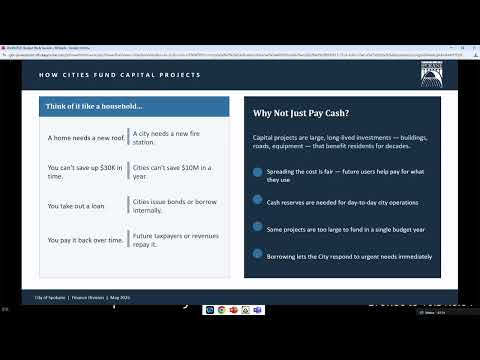
He described how SIP fits alongside other financing options available to municipalities: voter-approved general obligation (GO) bonds that require a 60% voter approval, council-authorized LTGO bonds, revenue bonds backed by dedicated enterprise rates, and commercial borrowing. Boston noted that LTGO bonds often offer lower interest costs than internal loans but said SIP provides speed and flexibility for smaller or mid-sized projects.
Boston also reviewed Section 85 of the Spokane charter and its practical effect on capital financing. "Section 85 ... a vote of the people shall be required for capital expenditures requiring a debt indebtedness of the taxpayers and property owners for capital projects," he said, adding that bond counsel has not found a similar charter requirement among Washington peers.
On current SIP activity, Boston said the city has outstanding SIP loans including roughly $6.8 million for fire capital and $6.0 million for PSAP facility and IT needs. He described SIP's financial benefits compared with commercial borrowing: a commercial loan for a similar term might be about 4.83% versus the SIP rate of the five-year federal rate plus 50 basis points (4.38 at the time he prepared the slides). Boston estimated the combined borrowing- and investment-return benefit at the city's present capacity yields roughly $170,000 a year in borrowing-cost savings and about $185,000 annually from recycled internal returns.
Boston warned that SIP use reduces portfolio liquidity and creates fixed debt-service obligations that departments must budget for. "It's not suitable for huge, huge capital projects," he said, explaining the program is intended for smaller or mid-sized needs and requires long-term planning to avoid crowding out other departments.
Councilors questioned practical constraints and long-term effects. Councilor Tarr asked how often the city has refinanced versus paid off five-year balloons; he said past loans were often refinanced rather than retired. "We've had a number of loans that we were nowhere close to having the money to pay them off, come year 5, and we'd refinance them," Tarr said. Boston replied the city could liquidate investments, sell securities or draw contingency reserves if necessary, but emphasized that legally reasonable revenue sources must back payments and that coordinated planning with departments is required.
Councilwoman Dillon asked for clearer debt projections and long-term funding road maps to increase transparency around which projects would draw on SIP and how repayments would be sustained. Boston said projections and capital plans are presented during budget development and committed to providing updated long-range projections as capacity is drawn.
No formal vote or council action on SIP policy or a specific loan was taken during the workshop. Boston said staff will return with updated projections; the next meeting will cover the general fund forecast as required by city code.
Ending: The workshop concluded with staff offering to follow up on questions; council members thanked staff and the session was adjourned without a formal vote.