Get Full Government Meeting Transcripts, Videos, & Alerts Forever!
Get email alerts on the Food Security topic
No spam. Unsubscribe anytime.
Agency official urges continued investment in food-recovery and local food-system resilience
Summary
An agency official told the State Board of Food and Agriculture that partnerships among farmers, food banks and public programs have expanded food-rescue capacity and called for more redundancy in local food systems, citing several recent public investments.
An agency official told the State Board of Food and Agriculture that California’s agricultural abundance does not eliminate persistent hunger and urged continued investments to move surplus food into communities served by food banks.
"We were doing ag vision" to examine why a state that grows plentiful nutritious food still records troubling hunger statistics, the agency official said, and described a planning process that included the then-executive director of the California Association of Food Banks. The official credited farmers and food-sector professionals with scaling food-rescue work and building partnerships with the State Board of Food and Agriculture.
The speaker said the COVID-19 pandemic exposed vulnerabilities in "just-in-time" food supply chains and argued for more redundancy, noting programs such as Barn2Family and capacity-building investments by food banks. "There’s never been a more important time for the work that you do," the agency official said.
The official cited public funding that has supported the effort: "when I think about the resilient food system infrastructure program from USDA, over $50,000,000 have been put into equipping small farms, small-scale aggregators," and, the official added, a local food procurement program provided about $14,000,000 to the California Association of Food Banks. The official also highlighted a $125,000,000 farm-to-school initiative intended to teach children healthy eating and support local food economies.
The remarks pointed to a range of investments aimed at strengthening the cold chain and local distribution, including refrigerated trucks, cold-storage and warehousing, and support for corner stores, farmers markets and mobile markets. The official characterized food banks as "the built-in community food hub for our communities" and mentioned Prop 4 in the context of tribal food-sovereignty programs.
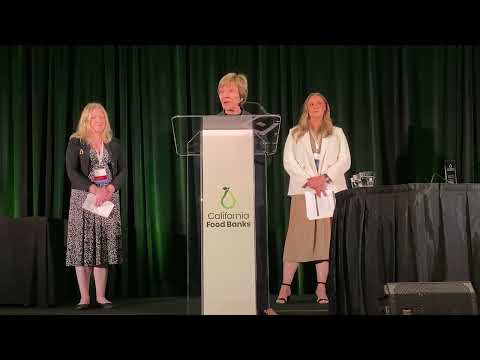
The official closed by thanking food banks for their work and accepting an award: "So thank you for what you do, and thank you for this award."