Get Full Government Meeting Transcripts, Videos, & Alerts Forever!
Get email alerts on the Rv Parking topic
No spam. Unsubscribe anytime.
Battle Ground study session on RV storage spotlights fire marshal concerns over eliminated setbacks
Summary
Council held a study session May 18 to review the recently adopted RV/trailer storage ordinance after the District 3 fire marshal warned removing setbacks raises the risk of fire spread and can limit firefighter access. Council directed staff to gather more data and involve fire and building officials in future code drafting.
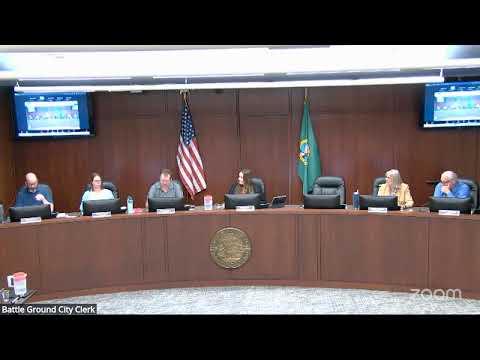
Deputy Mayor Vale opened a study session May 18 led by Deputy City Manager Rob Ferrier to review Ordinance 2026-04, the city’s new rules on storage of trailers and recreational vehicles in residential areas. The session followed a request from council members for further review after a letter from Fire District 3.
Chris Strone, fire marshal for District 3, told the council his April 20 letter explained the main concern: "Eliminating those setbacks and putting an RV or a trailer or boat closer to your neighbor's property line increases the likelihood of fire spreading to an adjacent property," and it can limit firefighter access for hose deployment and rescue. He said fire codes typically treat separation as a fire-safety issue and noted that many jurisdictions require about a five‑foot separation.
Deputy City Manager Rob Ferrier summarized the ordinance history, telling the council the code was adopted after public hearing and went into effect May 6. He said staff had sought an outside insurance opinion that indicated homeowner policies would generally not be affected. City Attorney Aziza Foster advised that, as a legislative act, council members and the city generally have legislative immunity from individual liability claims, but that the council can lawfully choose to impose setbacks by ordinance.
Council members pressed staff and the fire marshal for local incident data. Strone said District 3 had responded to 23 RV fires in the past five years and recounted at least one case where fire in a trailer spread into a residence. Several council members said that, given those safety concerns, they wanted additional analysis sooner than the previously discussed one‑year check-in.
Public comments during the study session emphasized neighborhood livability as well as safety. One attendee said opening yards to multiple RVs could be used for commercial parking and diminish property values; others urged balancing property‑owner rights with risk mitigation.
The council concluded by directing staff to bring back additional information—including local incidence counts, any insurance impacts, and written input from fire and building departments—and to involve those departments earlier in future code reviews. Members said they want the option to reconsider setbacks before the one‑year review if the new data indicate a clear safety risk.
The study session closed at about 6:47 p.m.; the full council meeting resumed at 7 p.m.