Get Full Government Meeting Transcripts, Videos, & Alerts Forever!
Get email alerts on the Public Private Partnerships topic
No spam. Unsubscribe anytime.
City staff outline steps, tools and results for Knoxville redevelopment incentives
Summary
City urban-design staff and KCDC walked Knoxville city council through the five-step process for public-private partnerships, explained when projects become public, and highlighted case studies including a $30 million Gay Street redevelopment and a $25 million Cumberland streetscape that officials say leveraged private investment.
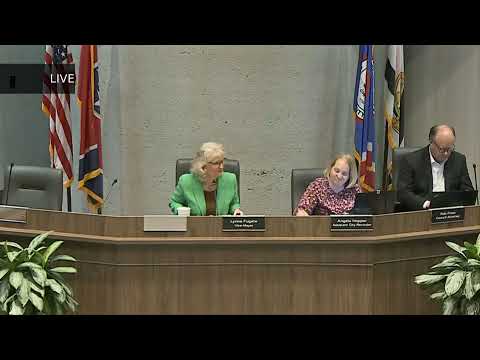
Vice Mayor Fugate opened a workshop and introduced Rebecca Jane Justice of the City's Urban Design and Development team and Ben Bentley of KCDC, who described the city's process for evaluating redevelopment incentives and public-private partnerships.
"We absolutely emphasize that the expansion of our housing supply is important when people are investing in residential projects," Justice said, describing the city's "key development priorities," which she said include encouraging workforce housing (she said staff typically ask developers to incorporate about 10 to 20 percent workforce units) and aligning projects with transit corridors, historic preservation and design goals. Justice pointed council members to the city's Urban Design web pages and a KGIS mapping viewer that shows redevelopment areas, prior partnerships and infrastructure layers.
Ben Bentley outlined a multi-step evaluation process intended to limit rework and ensure financial vetting: an initial Exhibit A application, a staff review, an internal interdisciplinary team review, a preliminary financial review (Exhibit B) and an independent third-party financial review before formal public approvals and final legal documents. "But all in all, this is, you know, roughly a 6 month process from start to finish if there aren't any major major hiccups in it," Bentley said.
Bentley and Justice said the timing when an incentive request becomes public-facing typically occurs as the project moves into third-party review (step 3), when staff have internal clarity that a project is likely to need a vote. They also described how entitlements such as rezoning, variances and design-review approvals normally should be resolved before detailed financial analysis to avoid redoing work.
The presenters walked council through multiple financing tools: redevelopment-area designations, tax-increment financing (TIF), pilot agreements, payment-in-lieu-of-tax arrangements, low-income housing tax credit collaborations, development agreements for infrastructure, capital-improvement investments and a facade/historic program for small-scale building envelope repairs.
Justice gave project examples to show how those tools have been used. The 200 Block of Gay Street, she said, was a publicly led RFP that converted a surface parking lot into a mixed-use project with 53 condo units (including workforce units), about 20,000 square feet of retail and project cost listed in slides as $30,000,000 with TIF support shown as 3,700,000. On Cumberland Avenue, Justice said the city invested roughly $25,000,000 in streetscape improvements that staff contend helped leverage about $1,000,000,000 in private investment along the corridor.
Bentley described how the city determines pilot or TIF durations through a model that evaluates a 10-year internal rate of return; he said the office has shortened typical durations in recent years so tax flows begin sooner and cited a group of Cumberland projects that are expected to deliver an estimated $4—$5 million a year in new tax revenue within five years. He said the third-party review frequently identifies items that change the financial assumptions and that the city aims for a consistent internal-rate-of-return range when evaluating proposals.
Council members pressed staff for early notice and involvement in the review process. Councilman Grant and others asked to be included earlier in step 1/b staff review so district representatives can provide local context; Justice recommended that applicants identify and notify district representatives and use KGIS maps to find them. Council members also discussed the city's practice of not generally incentivizing straight student-housing deals and noted that affordable tax-credit projects are vetted with different expectations.
Justice and Bentley highlighted broader program results since the city established the current framework in 2020: staff said public-private partnerships have inspired roughly $2,000,000,000 in private investment, created or preserved about 8,000 housing units (of which about 5,000 were affordable) and generated approximately $5,000,000 in new property tax revenue. Council members praised the work and asked staff to post materials online; Vice Mayor Fugate adjourned the workshop.
Why this matters: The presentation lays out the process and criteria that will shape which private projects receive public incentives and how the city balances financial risk, community benefits (including workforce housing) and infrastructure investments. Council members' requests for earlier notice could change how projects are discussed before formal approvals.
What to watch next: Council members may propose resolutions asking KCDC to draft new redevelopment-area boundaries or may request earlier briefings from staff on projects in their districts. The workshop produced information but no formal votes.