Get Full Government Meeting Transcripts, Videos, & Alerts Forever!
Get email alerts on the Land Use topic
No spam. Unsubscribe anytime.
Grant County APC subcommittee presses for bigger setbacks, water and power assurances in draft data‑center ordinance
Summary
A Grant County Area Planning Commission subcommittee reviewed a draft data‑center ordinance and, after technical discussion and public comments, signaled support for large setbacks (a quarter‑mile was proposed), detailed water‑use and cooling disclosures, backup‑power and staging plans, and monitoring and third‑party testing provisions.
The Grant County Area Planning Commission subcommittee met to review a draft data‑center ordinance and focused Thursday on definitions, siting limits and public‑safety protections, including setbacks, water use and power coordination.
The subcommittee’s president, Randy Atkins, opened the session by describing the body as advisory: the subcommittee will refine a draft that later goes to the full Area Planning Commission and then to county commissioners for final action. "Our goal tonight is to review the ordinance draft by section and or by page," Atkins said, adding the subcommittee’s recommendations are nonbinding.
Why it matters: members said they want rules that protect farmland, residents’ wells and county infrastructure while creating a predictable review path for large proposals. Multiple residents urged the panel to add numeric limits and stronger enforcement. "There's nothing in here that says how much electricity you're gonna use per acre, per mile, how much water is going to be used," said Sherry French, a downtown property and business owner.
Key decisions and proposals
- High‑impact district and special exceptions: The subcommittee kept the idea of a designated "High Impact District" (HID) where data‑center development would be considered. A HID would be created or established by the APC and any rezoning would still require county‑commission approval, putting siting decisions under a multi‑step public review instead of allowing facilities by right.
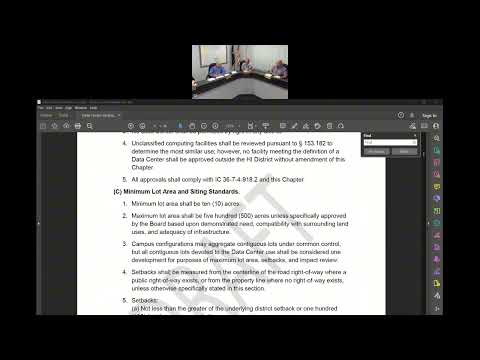
- Setbacks and lot size: Members debated numeric limits and settled on pursuing larger setbacks as the primary protective tool. Several members supported a quarter‑mile setback (about 1,320–1,420 feet) from nonparticipating property lines and residences; the same discussion considered limiting the maximum parcel size (the draft listed 500 acres; alternatives suggested 300 acres or under 100 acres). Todd, the planning staff member, cautioned that lot‑size caps interact with setback geometry and that the final language should avoid making the ordinance "impossible" to defend in court.
- Power supply, 'first rights' and phasing: The draft would require applicants to disclose total projected electrical demand and phase‑expansion plans. Committee members proposed requiring applicants to show how a facility could reduce demand during shortages (the subcommittee discussed a draft concept that the data center would curtail service before residential customers, which members called a "first rights" provision). The group asked for applicant plans that show how facilities would phase back online to avoid large restart peaks.
- Backup power and fuel storage: The draft requires on‑site backup capacity, and the subcommittee debated a 72‑hour baseline for continuity. Some members argued against setting upper limits on backup runtime because prolonged outages could require longer operation; others said fuel‑storage and spill risks justify clear county limits and monitoring.
- Cooling and water‑use transparency: The subcommittee agreed applicants must provide cooling‑system descriptions, estimated daily and annual water use, source of supply, and blowdown/recirculation management. Industry and technical witnesses explained that evaporative cooling towers typically use more water but are efficient; closed‑loop systems also dissipate heat and can raise local temperatures. "Evaporative systems are very costly for the company to utilize," said John McAdams, who identified himself as a local industry veteran, noting state rules govern discharge and chemical handling.
- Monitoring, reporting and enforcement: Members discussed requiring biannual (every six months) operational reports rather than annual ones, lowering the draft's 15% threshold for notifying the APC about year‑over‑year water‑use increases (10% was proposed as an option), and adding third‑party sampling after incidents. Several members stressed coordination with state regulators including the Indiana Department of Environmental Management (IDEM).
Public concerns and testimony
Residents made repeated, detailed objections focused on water, noise, health and local control. "The water that they take is at least 5,000,000 gallons a day," said Demiris Matthews, who described potential noise, light and health effects she associated with large data‑center operations. Pat Ansell, another long‑time resident, said her research identified a company name linked online to a proposed project spanning 753 acres and expressed concern about a nearby 3,200‑acre solar project that had been described on social media.
Several speakers urged the county to consider stronger rules or an outright ban. The subcommittee noted other jurisdictions have taken different approaches — from developing detailed ordinances to adopting bans — and said legal review would be required before adopting any provision that might expose the county to litigation.
What the draft will change next
Staff will incorporate tonight’s direction into a revised draft: tighten definitions, review setback math versus lot geometry, ask applicants for phased expansion plans and peak‑use estimates, strengthen monitoring and reporting language (including third‑party testing after incidents), and add PFAS and related contaminants to the environmental review checklist. The subcommittee also asked the county attorney to vet enforceability for provisions such as a "first rights" priority for residential power during shortages.
No formal vote or ordinance adoption occurred. Atkins closed the session after seven pages of a planned 37‑page draft had been reviewed and opened a general public‑comment period. The subcommittee said it will meet again after staff prepares revisions.
Quotes from the meeting
"Our intent in this ordinance is to address those areas," Randy Atkins said, listing infrastructure protections including electric, water, roads and emergency services.
"There's nothing in here that says how much electricity you're gonna use per acre... I mean, it's ridiculous," Sherry French said, urging numeric limits for energy, water and emissions.
"Evaporative systems are very costly for the company to utilize," industry witness John McAdams said, adding that state and federal rules govern chemical handling and wastewater that would limit discharges.
Next steps
The subcommittee will reconvene after staff integrates tonight’s feedback and legal review. The draft will then return to the full Area Planning Commission for a recommendation and later to county commissioners for final action.
(Reporting note: all quotes and attributions in this article come from statements recorded in the subcommittee transcript and were assigned to speakers whose names or roles were stated on the record.)