Get Full Government Meeting Transcripts, Videos, & Alerts Forever!
Get email alerts on the Instream Flow Restoration topic
No spam. Unsubscribe anytime.
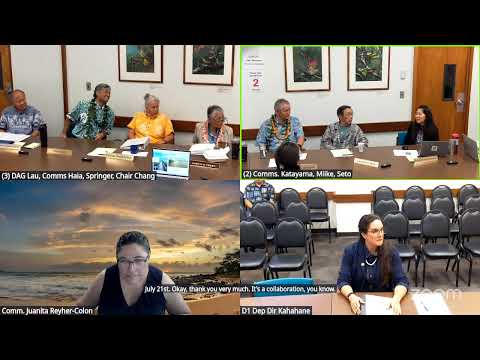
Mahi Pono update: commission hears progress on East Maui diversion modifications and community questions about permits and timing
Summary
Mahi Pono updated commissioners on implementation of diversion modifications stemming from earlier instream‑flow decisions; staff and community members pressed the company on remaining permits, Army Corps reviews, and the choice of modeling scenarios for an upcoming USGS study. Commissioners asked for timeline check‑ins and clarified that many pending permits are with federal agencies.
Commission staff and Mahi Pono gave a lengthy update on implementation of diversion modifications ordered by earlier instream‑flow decisions (2018 and 2022) for East Maui.
Staff summarized the history: multiple petitions and a drawn‑out contested‑case process produced measurable interim instream‑flow standards (IFS) for East Maui streams and ordered varying levels of restoration or connectivity for dozens of diversions. Dean and other staff described four categories of diversion work (from simple gate openings to major in‑stream construction) and said many modifications have been completed while others remain pending agency approvals, particularly from the U.S. Army Corps of Engineers.
Grant McCama, senior vice president at Mahi Pono, presented implementation numbers: the company said it has applied for and received dozens of permits across the 2018 and 2022 decisions, implemented temporary measures to return flow at 11 diversions and completed work on many category‑1 diversions. McCama said the operation currently diverts an average that staff described in the presentation as roughly 28 million gallons per day for the system in 2025 through April 2026, and that Mahi Pono uses groundwater and on‑farm storage to supplement surface flows. Mahi Pono also described voluntary interim measures that restore more flow than the permanent modifications required in some locations.
Public commenters and community groups pressed for faster implementation and for clarity about which permits remain pending. Jonathan Ulikeke Scheuer (consultant to DHHL) asked why a petition for designation of part of the system was not more visible in staff materials and urged that scenario choices for USGS runs be transparent given their policy implications. Kaye Anderson (Wailea 808) called for additional airborne electromagnetic surveys and immediate designation where appropriate. Wayne Tanaka of Sierra Club noted that Huelo modifications remain incomplete after multiple years and urged staff to identify choke points such as pending Army Corps reviews.
Commissioners asked staff to return with a clearer timeline of pending permit applications and recommended regular check‑ins with Mahi Pono. Staff said they will continue to work with USGS and federal agencies, and that some pending approvals are awaiting Army Corps and OCCL actions. The commission closed the non‑action update by asking staff for follow‑up briefings and status reports as the studies and permits progress.