Get Full Government Meeting Transcripts, Videos, & Alerts Forever!
Get email alerts on the Special Education topic
No spam. Unsubscribe anytime.
Director Dr. Kristen Chachaya presents special-education diagnostic review recommending more school-based capacity
Summary
The Rome City School District board heard findings from an EduSolve diagnostic review that called the district's special-education structure "over-centralized," recommended a tiered support model and more school-based professional development, and identified disproportionality in suspension and low least-restrictive-environment rates as priority targets.
The Rome City School District Board of Education on May 2026 heard a special-education diagnostic report, presented in partnership with EduSolve, that urged decentralizing decision-making and boosting school-based capacity to shift the district from a reactive to a proactive model.
Dr. Kristen Chachaya, director of special education, summarized the review's headline finding that much of special-education decision-making funnels through a single director, creating a "firefighting" approach rather than a consistent, district-wide continuum of services. Quoting a member of the review team, she said the approach captures the trade-off the district faces: "special education is driven by achievement but grounded in compliance." The review recommended expanding school-level capacity, clearer roles and a tiered system of supports.
Why it matters: district speakers said special-education enrollment is substantially above an expected 10 percent for a district of this size, and that the discrepancy has implications for instruction and compliance. Superintendent Anselm (first referenced in the presentation) told the board that systemwide reforms implemented last year corresponded with an approximate 7 percentage-point gain in ELA proficiency and a 2-point gain in math, but that subgroup performance and special-education indicators still lag.
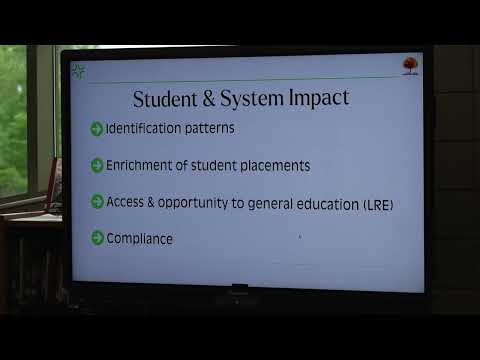
The report singled out two state accountability indicators as immediate priorities. The board heard that the district is under a corrective action plan for suspension disproportionality (indicator 4A) and that the district's least restrictive environment (LRE) rate was reported at about 26 percent against state expectations the presenters described as substantially higher. Dr. Chachaya emphasized that small counts can produce high disproportionality percentages (for example, suspending two students including one with an IEP can show up as a large percentage) and called for focused data monitoring and consistent implementation of IEPs across buildings.
Board members asked about early identification and family engagement. Dr. Chachaya said the district coordinates with Oneida County for early-intervention transitions into preschool and that the district is working to increase parent-response rates to a required state survey (she reported the office was about nine surveys short for the current indicator). The presenters recommended using the district's Parent Partnership Council and BOCES supports to increase family outreach and suggested consideration of a parent support group specifically for special-education families once system alignment improves.
The review's operational recommendations include: (1) structured professional development across all schools to build capacity; (2) a tiered supports model that targets buildings by level of need; (3) regular reporting and monitoring of IEP implementation; and (4) clearer distributed leadership so building staff can respond to routine issues without always escalating to the central office. Presenters said success would be measured by a reduction in over-identification, stronger alignment between IEPs and instruction, higher LRE percentages reflected in IDEA reporting, and improved student outcomes.
Next steps: the board received the report and asked staff to proceed with prioritized items including targeted PD attendance, a flag-review plan for concerning indicators and continued partnership with BOCES and other providers. The presentation concluded with an introduction of the special-education coordinators (Dana Ealy, Kristen Lepata and new coordinator Josh Nitty) and a note that the department still seeks one additional coordinator and faces national shortages in school psychologists.