Get Full Government Meeting Transcripts, Videos, & Alerts Forever!
Get email alerts on the Grants topic
No spam. Unsubscribe anytime.
ONDCP and CDC outline FY26 CARA grant eligibility, application requirements and timeline
Summary
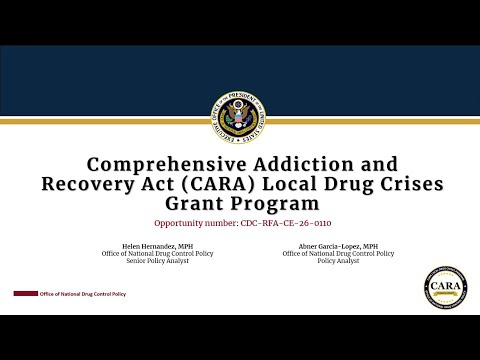
ONDCP and CDC hosted a webinar to explain the FY26 Comprehensive Addiction and Recovery Act (CARA) Local Drug Crises NOFO (CDC RFA CE 26 0110), including eligibility rules (must be current/former DFC recipient and able to receive federal funds), required documents, and a grants.gov application deadline of 06/08/2026; applicants are urged to confirm registrations early.
ONDCP and the Centers for Disease Control and Prevention on the webinar introduced the FY26 Notice of Funding Opportunity for the Comprehensive Addiction and Recovery Act (CARA) Local Drug Crises grant program (CDC RFA CE 26 0110) and reviewed who may apply, what must be submitted, and where to find the NOFO.
Helen Hernandez, senior policy analyst at the White House Office of National Drug Control Policy (ONDCP), told attendees the NOFO is posted on grants.gov and reminded applicants that submissions must be uploaded there and received by 06/08/2026; she emphasized that late applications will not be accepted. Abner Garcia Lopez, a policy analyst on the DFC-in-CARA program, said roughly 50 community coalitions are expected to be funded with a program-level total of about $3,750,000 and awards of approximately $75,000 per year under a five-year period of performance.
Karen Vetsch, branch chief for the DFC and CARA programs at CDC, said applicants must meet every statutory eligibility requirement to advance beyond initial review. ‘‘Applicants must meet every statutory requirement to be eligible for funding, and failure to meet even 1 requirement will result in an application being deemed ineligible and not moving forward to merit review,’’ she said. CDC’s requirements include the ability to legally receive federal funds (either the coalition itself is a 501(c)(3) or the coalition partners with a fiscal agent that is eligible to receive federal funds and submits a signed memorandum of understanding) and that the applicant is a current or former Drug-Free Communities (DFC) recipient.
The NOFO requires applicants to demonstrate that local rates of opioid or methamphetamine misuse are higher than the national average (applicants may use national comparators such as the Monitoring the Future survey or the National Survey on Drug Use and Health). CDC clarified that, given methodological changes in national surveys, applicants only need to show higher rates for one point in time rather than a sustained period. Awardees will be required to participate in the CARA National Cross-Site Evaluation and collect core measures (including past 30-day prescription drug misuse and youth perception of risk) in at least three grades between sixth and 12th.
The webinar walked through the application components and scoring: the project narrative (20 pages) is scored out of 100 points (background and approach; evaluation and performance measurement; organizational capacity), and the work plan must include a detailed 12-month action plan with SMART objectives. CDC listed required attachments: a table of contents for the submission, coalition meeting minutes from January 2025 through the application deadline that list attendees and sector representation, a statement of legal eligibility (501(c)(3) proof or fiscal-agent signatures and MOU), disclosure of prior DFC funding, resumes and job descriptions for key personnel, and an overlap report if funding is requested from another source for the same fiscal year.
Karen Vetsch also reviewed key personnel expectations (an Authorized Organization Representative and a Program Director/Principal Investigator who cannot be the same person), budget narrative instructions (itemized justification and indirect cost documentation if claiming indirects), and standard federal forms that must be included (e.g., SF-424, SF-424A, and SF-LLL if applicable). CDC advised applicants to confirm SAM.gov and grants.gov registrations and UEI early, use the NOFO application checklist, upload attachments in the Other Attachments form, and save grants.gov confirmation receipts.
For additional information and questions as provided in the webinar slides, attendees were directed to the NOFO posting on grants.gov and to the contact points listed in the presentation (presented in the webinar as "caranofocdc dot gov" for NOFO questions and "dfcogscdc dot gov" for grants management questions). The NOFO contains the definitive submission instructions, formatting requirements and exact cutoff time for the application; applicants should consult the NOFO on grants.gov and the posted supporting materials for precise instructions.
The webinar closed with reminders about post-award responsibilities (CDC terms and conditions, HHS grants policy, monitoring and reporting requirements, and required training) and the recommendation to submit applications at least 48 hours early to avoid technical issues.