Get Full Government Meeting Transcripts, Videos, & Alerts Forever!
Get email alerts on the Budget topic
No spam. Unsubscribe anytime.
Grass Valley Measure B committee recommends preliminary FY26-27 budget, funds nine firefighters and vegetation programs
Summary
The Measure B advisory committee voted unanimously to recommend a preliminary fiscal-year budget to the City Council that funds nine firefighter positions, a vegetation-management program including a proposed defensible-space inspector, $250,000 in fuel-reduction microgrants and staff-led grant efforts including a near-term $700,000 award pending deposit.
The Measure B advisory committee on May 19 voted to recommend a preliminary FY26-27 budget to the Grass Valley City Council that would fund nine firefighter positions and expand vegetation-management programs aimed at fire resiliency.
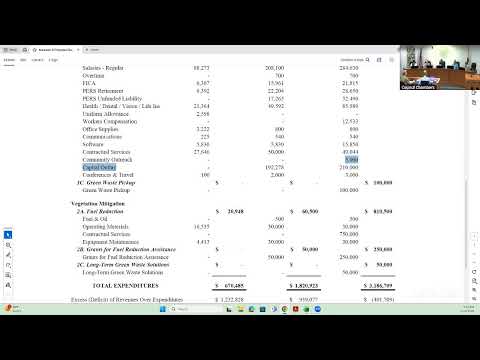
Alex Gamelgaard, identified in the meeting as police chief and interim city manager, told the committee Measure B is a 3/8-cent sales tax that began partial collections in October 2024 and that staff projects $2,680,000 in sales-tax receipts for the coming year and $2,785,000 including interest. "2,680,000 is what is anticipated in revenues for this coming year," he said, noting Measure B revenue is tracked in a separate fund and not commingled with the general fund.
Why it matters: Measure B money pays for personnel and programs intended to reduce wildfire risk across the city, including firefighter staffing, defensible-space inspections and grants to help homeowners harden properties. Maintaining a significant fund balance — Gamelgaard described a cushion around 50% — would let the city continue some work if the tax is not renewed when it sunsets.
Committee discussion and program details Gamelgaard outlined the top-line expenses as firefighter allocations, operating materials and a vegetation-management program labeled "1b" in the packet. In all, the Measure B program is budgeted to pay for nine firefighter positions, a change that moves engines from two-person to three-person staffing across three stations. "The additional staff has just been absolutely phenomenal for us," Fire Chief Mark Buttern said, describing improved response times, reduced tasking and higher morale.
Staff identified a proposed new position described as a defensible-space inspector/analyst to administer community grants and manage vegetation work. The packet includes a line of $250,000 for "grants for fuel reduction assistance," which staff said would become a microgrant program to help economically disadvantaged or physically unable homeowners address zone-0 and zone-1 home-hardening tasks.
Grants and external funding Dwayne Strausser, the staff member leading vegetation-management and grant efforts, presented a grants inventory and said many applications remain pending. He described a near-term award from the Sierra Nevada Conservancy of about $700,000 to cover roughly 240 acres — spanning the Berryman Ranch area, the Wolf Creek corridor and the fairgrounds — and said the county has agreed to provide $25,000 in matching funds for a Slate Creek evacuation-clearing project. Strausser cautioned the city will not record awards until funds have been received and deposited: "I wouldn't in good conscience, portray that to you until the money's in the bank," he said.
Staff emphasized a strategy of pursuing grants that minimize cash-match requirements and using in-kind staff time and equipment when matches are required. Committee members pressed staff to show how grant-writing and awarded projects will be reflected in city accounting; Gamelgaard said awarded external grants will be entered into special-project funds when cash arrives while certain staff and capital costs remain in the Measure B fund.
Other budget items and program design Committee members queried a proposed $10,000 increase tied to evacuation-modeling software that would be compatible with neighboring jurisdictions, and asked about a modest outreach budget ($3,000–$5,000) for conferences, tabling and public education about defensible-space inspections. Staff said program eligibility and microgrant thresholds will be tightly vetted to prioritize hardship and low-income households.
Legal and operational context Staff noted the city can use municipal-code abatement procedures and an existing defensible-space ordinance to require hazardous vegetation removal after a nuisance determination, but emphasized enforcement is complicated in locations where trespassing and homelessness are factors (a corridor behind a Raley's shopping center was discussed as an example). Staff also said the city's defensible-space rules have been updated to align with neighboring jurisdictions and state law.
Vote and next steps After questions and closing comments, a committee member moved to adopt the preliminary Measure B budget for review by City Council; the motion was seconded and the committee voted unanimously to recommend it. The committee asked staff to clarify the grants-for-fuel-reduction language before submission. Per the city charter cited in the meeting, the City Council is required to adopt the city budget before July 1.
Actions at a glance - Motion to approve meeting agenda — moved, seconded and approved during opening proceedings. - Motion to recommend the preliminary Measure B budget to City Council — moved, seconded and approved unanimously; the transcript does not record a roll-call with named yes/no tallies.
What remains open Staff and the committee will finalize program design for fuel-reduction microgrants and will clarify budget language on grants before the packet goes to City Council. Several external grant awards described in the presentation remain pending until funds are received and entered into the city's accounts.
(Reporting note: names and roles are taken from speaker identifications and introductions given in the meeting transcript; some award amounts and grants discussed were described as pending and not yet recorded in city bank accounts.)