Get Full Government Meeting Transcripts, Videos, & Alerts Forever!
Get email alerts on the Grants And Funding topic
No spam. Unsubscribe anytime.
MassDEP reviews ECSDC grant timelines, compliance requirements and UMass technical support for grantees
Summary
MassDEP's Drinking Water Program briefed ECSDC grantees on federal allocations, six-year project timelines, contracting steps (UEI/COMMBUYS), reimbursement documentation, Build America Buy America thresholds, cybersecurity for operational technology, permitting and technical assistance available from UMass.
Abby Jacobs, ECSDC grant program manager at the Massachusetts Department of Environmental Protection's Drinking Water Program, told webinar attendees the EPA-funded Emerging Contaminants in Small or Disadvantaged Communities (ECSDC) program is intended to help small or disadvantaged public water systems address contaminants such as PFAS and manganese. She summarized EPA allotments by work-plan year and said the four work-plan years total about $95.6 million in federal funds.
At the start of grant administration, Andrew Andresco, program coordinator for the ECSDC grant at MassDEP's Drinking Water Program, walked grantees through the post-award process: recipients receive an award letter, complete a contract intake form, return documents for MassDEP review and, once the contract is executed, receive a notice to proceed that includes invoice and reporting templates. "It's at that point that you can begin submitting invoices for reimbursement," Andresco said, and he urged grantees to read the notice to proceed carefully.
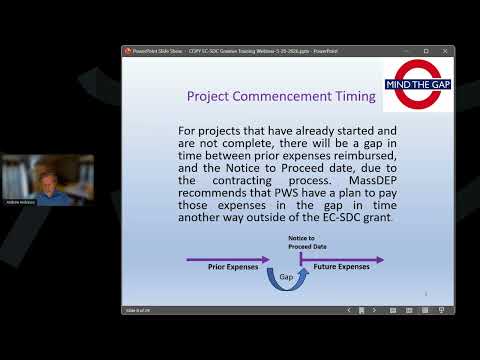
Andresco highlighted two recurring onboarding issues: the federal Unique Entity Identifier (UEI), which replaced DUNS, and vendor setup in COMMBUYS so MassDEP can issue payments. He encouraged grantees who lack a UEI or COMMBUYS registration to reach out to program staff for help. He also warned of a "gap" that can occur between submitting scope/prior-expense documentation and receiving a notice to proceed; that gap can be "anywhere from one to two months," he said, and expenses incurred before the notice may not be reimbursable until the notice is issued.
On reimbursements, Andresco said invoices must show the date or date range when work was actually performed (the program cannot accept invoice date alone) and must include proof of payment (canceled check, ACH/wire confirmation or equivalent). He described the invoice template included with the notice to proceed and detailed how to fill prepopulated fields and the grant-balance table, asking grantees to submit invoices to the program director's email and to cc the program coordinator for processing.
Jacobs reviewed federal compliance requirements tied to the grants. For infrastructure or construction projects with awards over $250,000, Build America Buy America (BABA) rules apply to iron, steel, manufactured products and construction materials used in permanent structures; Jacobs noted BABA waivers exist (de minimis, certain pre-2022 designs and project-level waivers) and directed grantees to EPA's BABA resources for examples and waiver procedures. "For a lot of you, it might not apply at all because maybe your project is only research and testing," she said, but emphasized that when BABA does apply it covers the entire project, not just the grant-funded portion.
Jacobs also explained cybersecurity requirements for projects that include operational technology (OT) — defined as hardware or software that directly monitors or causes changes to water treatment or distribution processes and that is remotely or network-accessible. Projects with OT must document a cybersecurity assessment performed with EPA or CISA or complete a self-assessment within 30 days; systems without OT can submit an exemption form (ERP CSOT). MassDEP will share cybersecurity information with its cybersecurity team and maintains a resource hub for Massachusetts public water systems.
On permitting and environmental review, Jacobs reminded grantees they are responsible for obtaining required local, state and federal permits. MassDEP-related forms include distribution modification forms (WS-32/33), new source and treatment plant forms (WS-21—WS-25), construction and facility modification permits, well driller and groundwater forms, and others. She also discussed the Massachusetts Environmental Policy Act (MEPA) and when environmental notification forms or MEPA review may apply (for significant construction, wetland impacts or large new water sources) and advised grantees to consult engineers and the MEPA team for advisory opinions.
Jacobs reminded recipients that federal single-audit requirements can apply to projects spending more than $1,000,000 in a fiscal year and asked grantees to respond promptly (within a 72-hour window where possible) to MassDEP communications about contracts, reporting or scope changes. She said monthly progress reports will be provided with the notice to proceed and are due by the 15th of the following month even when no work occurred; the final report should include accomplishments, photos, data and lessons learned.
Eric Lee, a UMass Small Water Systems technical assistance provider, described assistance available to grantees: project planning, budgeting, compiling eligibility documents, pilot testing and sampling (particularly for PFAS and sometimes manganese), and support leading up to hiring consulting engineers. He cited recent examples of funded projects — South Royalston ($115,000 for a manganese treatment system), New Salem ($73,000 feasibility study) and Montague Center ($100,000 feasibility study) — to illustrate how technical assistance and feasibility work feed into design and construction planning.
Jacobs closed by announcing another ECSDC funding year will be available through 2032 and encouraged any public water system advancing to next-phase work (pilot'construction) to submit a needs-assessment survey with subject line "ECSCC needs survey" to program.director-dwp@mass.gov so staff can consider additional funding. The presenters shared contact emails for follow-up and invited questions as the recorded portion of the webinar ended.