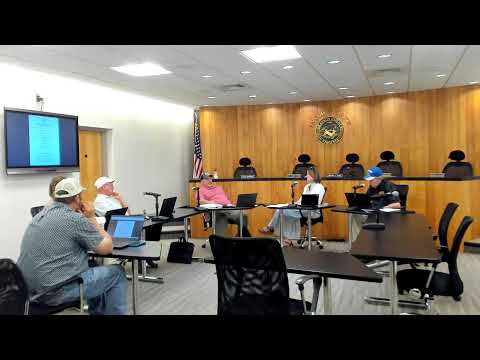
State solar and battery-storage laws force changes to Grayson County ordinance
Summary
Planning staff briefed the commission on new Virginia legislation (SB 347, SB 443) that limits certain local standards, requires reporting special-use decisions to the State Corporation Commission, shortens some setbacks, raises panel/fence heights for agrivoltaics, and mandates periodic decommissioning and DEQ stormwater compliance.
Planning staff told the commission that recent legislation requires the county to revise its solar and battery-storage regulations. Miss Blackett summarized the changes in Senate Bill 347 (solar) and Senate Bill 443 (Battery Energy Storage Systems), saying the legislation "clarifies local authority and limitations" and obligates localities to report special-use decisions to the State Corporation Commission.
Key changes staff flagged include revised setback and height standards (for example, a property-line setback discussed in the packet shifts from about 150 feet to 75 feet and dwelling setbacks from 250 to 200 feet), higher panel/fence heights for agrivoltaic installations (discussion noted an increase from a 15-foot limit to up to 25 feet at full tilt), and changes to density standards that the new law may preempt. Miss Blackett said battery energy storage systems "have to be allowed by right in all zone districts within the county," reflecting the statute's limits on local exclusionary rules.
Operational requirements: The commission was told the law requires the county to provide the State Corporation Commission with a record of special-exception decisions within 60 days of a decision and that decommissioning language now requires certified professional review of decommissioning bonds every five years. Staff also said battery-storage installations must comply with applicable fire, building and electrical codes and that the county should incorporate emergency-response planning and public-safety coordination into its rules.
Next steps: Staff will circulate a Sands Anderson webinar and recommended language (including sample language from Charlotte County) to commissioners and will consult retained counsel (Michael Zayner and the county attorney) to reconcile the county’s existing ordinances with the statutory requirements. Miss Blackett emphasized there were no known local solar or battery projects pending yet but that the changes must be prepared for adoption.
The commission did not take formal action on ordinance language at this meeting; staff said revised language will be returned for review and public hearing once attorneys confirm allowable provisions.
AI generated
The text on this page is AI generated. Summaries, highlights, analysis, and video transcripts are all produced from the original source material.
AI can make mistakes, so if you spot one, and we will fix it for everyone.
Note: the source content is unaltered by us. Any content source we link to, be it a video, an audio recording, or a document, is presented exactly as its publisher released it. That publisher is usually a government body, sometimes an individual official or another organisation.