Get Full Government Meeting Transcripts, Videos, & Alerts Forever!
Get email alerts on the Public Health Budget topic
No spam. Unsubscribe anytime.
Boston Public Health Commission outlines FY27 priorities and equity investments as federal support shifts
Summary
At a May 21 Ways and Means hearing, BPHC Commissioner Dr. Vassolo Ojikutu presented the commission's FY27 operating budget and highlighted equity-focused investments, recovery and shelter outcomes, and capital projects while warning of waning federal one-time funds.
Chair Ben Weber convened the Ways and Means Committee on May 21 to review the Boston Public Health Commission's proposed FY27 operating budget. Dr. Vassolo Ojikutu, BPHC commissioner and executive director, told councilors the commission's work is centered on the Live Long and Well population health equity agenda, aimed at closing life-expectancy gaps across neighborhoods and racial groups.
Ojikutu cited stark disparities in life expectancy and said the commission is directing new investments toward neighborhoods with the lowest life expectancy. He described three targeted grants: a $5 million community-led investment (part of a $10 million pledge from the Atrius Health Equity Foundation to be disbursed over multiple rounds), $1 million dedicated to Black men's health programs, and a new $1 million partnership with the Dana-Farber Cancer Institute for prevention and community outreach.
The commissioner also reviewed recovery-services and homeless-services work. He said PATHS, the commission's open-door referral program for substance use disorder treatment, recorded 1,274 client placements through April 30 of FY26. BPHC said its Mattapan campus'based transitions program had 621 admissions through April 20 and highlighted programs that allow stable access to methadone and gender-specific residential treatment for pregnant and postpartum people.
On homelessness, Ojikutu described city-run shelters (112 Southampton St. and Woods Mullen) and low-threshold services co-located at those facilities. He reported that in FY26 through April 1 the commission served 2,884 unique shelter clients, provided 643,942 meals, and had 182 individuals move into permanent housing and 163 receive job training. In an earlier slide the presentation also referenced "80 clients" placed into permanent housing in a program-specific context; the commission said it would provide follow-up data if councilors requested reconciliation of those figures.
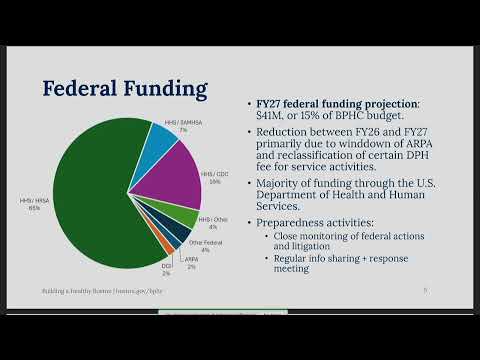
Budget mechanics and external funding were a central theme. Christopher Valdez, BPHC budget director, told the committee that the city appropriation comprises one component of the commission's revenue and that for FY27 the appropriation-related streams are expected to cover 72% of the budget, federal sources about 15%, state sources about 8%, and other sources (including opioid settlement dollars) roughly 5%. Valdez said rising fringe costs'notably a projected 5% increase in pension expenses and a more than 20% rise in health care premiums'required an accounting approach that excluded fringe from FY26 base values before applying mayoral target reductions and then adding new fringe estimates back in, producing a year-over-year appropriation increase Valdez characterized as 1.6% that preserves staff and services.
Valdez and Ojikutu said some federal grant levels declined as ARPA-related work wound down, but that BPHC had not yet had any federal grants formally rescinded. On opioid settlement funds, the commission said it has roughly $18 million budgeted over a four-year spending plan and expects additional settlement receipts through 2040; it plans to use settlement dollars for housing, case management and community-based overdose-response work and to issue an RFP in June for community "boots on the ground" activities.
Commission leadership also described capital and systems investments: a new two-bay EMS station on the South Boston Waterfront expected to open this summer; forthcoming upgrades to CMED (central emergency medical direction) and the department's radio infrastructure; and a multi-year ambulance procurement expected to add roughly 26 vehicles across FY25'FY27 orders.
Why it matters: councilors pressed for specifics about program outcomes, staffing and long-term sustainability as one-time federal funds decline. Councilors requested follow-up documents, including reconciled placement counts, detailed vacancy listings and promotion-and-recruit-class diversity breakdowns. The commission said it will provide those materials and noted several items will return for fuller discussion in an afternoon session focused on infectious disease and behavioral health.
The committee recessed and reconvened later in the day for additional BPHC topics, including behavioral health and violence prevention.