Get Full Government Meeting Transcripts, Videos, & Alerts Forever!
Get email alerts on the School Facilities topic
No spam. Unsubscribe anytime.
Facilities chief details summer projects, cites a canopy bid well above estimate
Summary
Mr. Muse told the Tangipahoa Parish capital outlay meeting about completed school repairs and planned summer maintenance (gym floors, athletic fields) and flagged budget pressures after an O.W. Dillon carpool canopy bid came in at roughly $453,000 versus an estimated $320,000. Several members urged clearer review thresholds and prioritization for flood-prone schools.
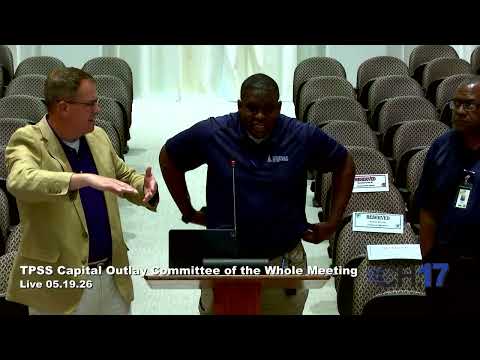
Mr. Muse, the facilities presenter for the Tangipahoa Parish capital outlay meeting, gave the board an overview of recent school repairs and outlined a busy summer schedule that will include gym-floor maintenance across roughly five gymnasiums and a new program to perform aeration, top‑dressing and chemical maintenance on all parish athletic fields.
"We got the items that we completed, and I'd like to spend just a little bit of time on the upcoming projects," Mr. Muse said as he opened a slide presentation listing completed and planned work across the parish.
The presentation listed contractor assignments and costs for several site-specific projects. Mr. Muse said Hammond High School’s batting cage was rebuilt and completed "about $38,000," and that Hammond would install new stage curtains paid by the school at an estimated $35,000, with installation scheduled for May 20. He also noted delays for Punctitula High’s new football lockers because "the vendor couldn't get parts to build it," with the shipment expected Aug. 7 and installation targeted for Aug. 16.
A major procurement concern centered on a planned carpool canopy at O.W. Dillon. Staff described a probable project estimate of about $320,000 but said the lowest bid received was approximately $453,000. "The probable cause for that project was at 320,000, and the lowest bidder, right now is at $453,000," a staff member reported. The architect had not yet submitted a recommendation, and board members asked whether the design or choice of materials (structural steel versus structural aluminum) was driving costs.
Board members pressed staff for clearer rules about which projects come to the board for review. One member said they sometimes see reports for schools in their district without drawings or prior notice and asked to be more involved in planning. Staff replied that projects below a cost threshold are often handled between principals and facilities; if a principal lacks school funds and requests capital outlay assistance, staff can place that request on the board agenda for approval.
Members also raised safety and recurring maintenance needs. A board member reminded the group that Sumner and Roseland campuses have experienced repeated water intrusion at classroom doors; staff said they have quotes for front‑gutter work and plan to route water to surface or subsurface drainage to prevent future classroom flooding.
The presentation included before-and-after photos of parish work — press box repainting, new turf, locker and floor installations, canopy walkways and Innovation Lab flooring — and staff said some projects were paid with school activity funds rather than central capital outlay. Throughout the meeting, members asked staff to clarify which funding sources apply to which projects so the board can better prioritize work across campuses.
Staff and board agreed to place certain air‑conditioning and maintenance items on the June 16 agenda; the chair then adjourned the capital outlay meeting and moved directly into a finance meeting.
What happened next: there were no formal motions or recorded votes during this presentation. Several board members asked staff to provide clearer procurement recommendations and to raise specific principal requests to the board when capital outlay funding is required.