Get Full Government Meeting Transcripts, Videos, & Alerts Forever!
Get email alerts on the Retiree Health Insurance topic
No spam. Unsubscribe anytime.
TRS webinar outlines TRIP and TRAIL rules, enrollment windows and steps to transition to Medicare Advantage
Summary
Sandy, a presenter for the Teachers' Retirement System, summarized differences between TRIP (pre‑65) and TRAIL (Medicare Advantage), eligibility rules (8 years of TRS service), key enrollment windows (TRIP May 1–June 1; TRAIL mid‑Oct–mid‑Nov), and the actions members should take to move from TRIP to TRAIL.
Sandy, a presenter with the Teachers' Retirement System (TRS), walked retirees and near‑retirees through TRS's two primary health options — TRIP for those not yet on Medicare and TRAIL, a Medicare Advantage MAPD plan — and the steps members must take during benefit choice and transition periods.
Sandy said TRIP (Teachers Retirement Insurance Program) is the pension system’s primary medical coverage for members before Medicare eligibility and includes medical, prescription drug, dental and vision benefits for members and dependents. TRAIL (Total Retiree Advantage Illinois) is the TRS Medicare Advantage plan available to members who enroll in Medicare Parts A and B; its open enrollment runs mid‑October through mid‑November with a January 1 effective date.
The webinar reiterated eligibility rules: retirees must have at least eight years of TRS service credit to enroll in TRIP or TRAIL; service accrued in other retirement systems does not substitute for TRS's eight‑year requirement. Enrollment in the TRS programs is optional — members may enroll at retirement, during annual open enrollment, or after the loss of other coverage with appropriate documentation.
Sandy reviewed the practical steps members should take when approaching Medicare eligibility. About 90 days before a member or dependent turns 65, TRS mails an “age 65” letter that includes a TRAIL checklist. Members should apply to the Social Security Administration for Medicare Parts A and B, obtain a Medicare card, and then upload a copy or photo to their TRS account or mail it to TRS. Members also need to contact the myBenefitsServiceCenter vendor the month before Medicare eligibility to request enrollment in TRAIL if they choose that option. TRIP coverage ends the last day of the month before a member becomes Medicare eligible.
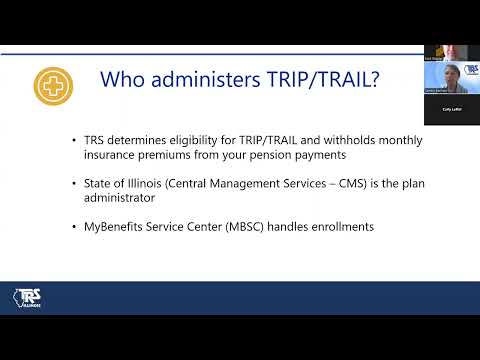
Sandy clarified administrative roles: TRS determines member eligibility and withholds premiums from pension checks; Illinois Central Management Services (CMS) serves as plan administrator and contracts with carriers; and myBenefitsServiceCenter processes enrollments, cancellations and dependent eligibility documentation.
The presenter walked through plan types and examples shown on the slide deck. Managed care/HMO and open access plans are generally regionally offered (many HMOs are specific to Illinois and bordering counties), while the TRS PPO — Teachers' Choice Health Plan — is available nationwide. Sandy explained the differences: HMOs typically require a primary care physician and referrals for specialists; open access plans let members see providers without referrals but apply tiered cost sharing (tier 1/2/3); and PPOs provide the broadest access without referrals but often at higher premiums.
As shown on the presentation slides, TRS provided example premium figures that will take effect on July 1. (Readers should consult TRS's posted benefit summaries or the slide booklet for exact, authoritative premium amounts and any transcription artifacts.) Sandy also emphasized that once a member becomes Medicare eligible, TRAIL premiums are generally much lower than TRIP premiums and that Medicare Part B is a separate charge paid to Medicare that varies by household income.
During a long Q&A, participants asked about tax treatment (Sandy: TRIP and TRAIL premiums are withheld on a posttax basis), whether a younger spouse must wait for TRAIL (Sandy: a younger spouse may be added to TRIP before age 65; TRAIL applies when that dependent becomes Medicare eligible), where to check provider networks (use carrier links on the TRS website plan pages), international emergency coverage (contact the carrier for details), and whether underwriting is required to join TRAIL later (Sandy: there is no underwriting for eligibility; members may enroll during TRAIL open enrollment or when other coverage ends).
Sandy closed by reminding attendees that the webinar recording will be posted to the TRS website and YouTube channel, and that TRS, CMS or the carriers should be contacted for detailed coverage or formulary questions. The moderator said the panel would continue answering questions in the Q&A thread after the formal recording ended.
The webinar is intended as guidance on enrollment mechanics and plan differences; for plan‑specific coverage, provider lists, formularies or precise premium calculations, TRS directed members to the official benefit choice summaries and the myBenefitsServiceCenter and carrier contacts listed on the TRS website.