Get Full Government Meeting Transcripts, Videos, & Alerts Forever!
Get email alerts on the Health Budget topic
No spam. Unsubscribe anytime.
Health Department budget recommended after committee discussion on staffing and opioid task force
Summary
The committee recommended approval of Salem City's Health Department FY2027 personnel and expenditures budgets, including conversion of one grant-funded post to a full-time position; members also discussed code enforcement inspections, vaccine clinics and plans to stand up an opioid-settlement task force in July 2026.
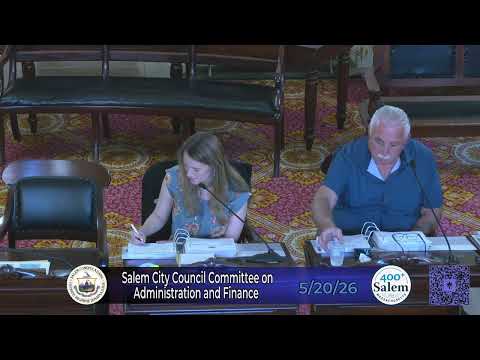
The City of Salem Committee on Administration and Finance on May 2026 recommended approval of the Health Department’s FY2027 personnel and expenditures budgets after a presentation by Dave Greenbaum of the department.
Greenbaum told the committee the department is “basically level funded” for FY2027 but is moving one position from a grant line to the full‑time positions line. “There is 1 position added. That position is currently in the department as a grant funded position that is moving from the grant line item to the full time positions line item,” he said. He added that other increases reflect cost‑of‑living or contractual obligations.
Councilors pressed for details on how the change would affect services. Councilor Jurowski praised the new code enforcement officer’s work on certificates of fitness, saying the position has “made it easier for people to comply.” Greenbaum confirmed that the officer is enforcing a three‑year certificate‑of‑fitness cycle and has increased inspection throughput: after working through street listings alphabetically, the officer is rechecking nonresponders and issuing follow‑up notices, with enforcement escalating to a $50 ticket when outreach fails.
Councilor King asked about short‑term rentals and whether they fall under the code enforcement officer’s duties; Greenbaum said short‑term rental inspections are done by other staff for now. King also noted downtown naloxone (Narcan) boxes and pressed Greenbaum to describe the makeup and timing of the opioid‑settlement task force. Greenbaum said the department ran community engagement last year and expects the task force to be formed and meeting by July 2026, with participation from regional partners (hospital, community health center, LifeBridge) and people with lived experience to guide spending decisions.
Councilor King moved to recommend approval of the Health Department personnel budget in the amount of $745,767; the motion was seconded and recorded as carrying by a 4‑hand favorable indication. King then moved approval of the department’s expenditures budget ($127,139); that motion also carried, bringing the department total to $872,906 for FY2027.
The committee discussion also covered contracted services (technical reviews such as Title 5 septic and specialized pool filtration reviews) and public‑health outreach such as vaccine clinics on Congress Street. Greenbaum said contracted services are used when technical expertise is required beyond in‑house capacity. The Health Department said it will prioritize community input before allocating the bulk of opioid‑settlement funds.
Next procedural steps: the committee forwarded the Health Department recommendations for inclusion in the FY2027 budget process.