Get Full Government Meeting Transcripts, Videos, & Alerts Forever!
Get email alerts on the Land Use topic
No spam. Unsubscribe anytime.
Palm Coast Council Approves MPD Change Reducing Density but Rejects Affordability Conditions, 3–2
Summary
The Palm Coast City Council voted 3–2 to approve a first amendment to the Palm Coast Park Master Plan (MPD application 6431), reducing entitlements from roughly 320 townhomes to about 244 single‑family lots while allowing smaller lots and one‑car garages; council members and residents clashed over workforce affordability, lot sizes, and potential long‑term impacts.
The Palm Coast City Council voted 3–2 on May 19 to approve a first amendment to the Palm Coast Park master plan development (MPD application 6431) that reduces overall density and changes product types, a move supporters said lowers pipeline housing counts and opponents said missed an opportunity to secure workforce‑housing guarantees.
Estelle Lentz of Community Development told the council the applicant revised plans since the first reading to add enhanced landscape breaks (a 20‑foot buffer every 12 lots) and a small neighborhood amenity. "They did revise the conceptual plan," Lentz said, describing the added playground/amenity area and buffers.
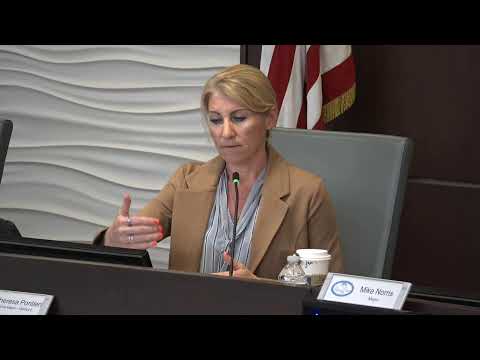
Councilman Gambarro moved approval with the change requested by the Planning and Land Development Regulation Board to convert permissive amenity language from "may" to "shall" so the project must provide active recreational elements; Councilman Miller seconded the motion. After public comment and deliberation, the motion passed 3–2 (Gambarro, Miller and Mayor Michael Norris voting yes; Vice Mayor Pontieri and Councilman Sullivan voting no).
Supporters of the amendment cast the change as a net reduction in potential housing units. "Less density," Mayor Michael Norris said during the motion, framing the amendment as removing entitlement rather than adding it. Council supporters also said the MPD approach preserves master‑plan governance and homeowner‑association protections that can reduce future blight.
But several council members and commenters urged stronger affordability commitments. Carla Amaral, vice chair of the Affordable Housing Advisory Committee, urged the council to ask "what public benefit are we receiving in return?" She warned the ordinance grants significant economic incentives—smaller lots, reduced setbacks and lower minimum living areas—without an affordability covenant, workforce set‑aside, or AMI targets.
"If the city is creating substantial economic value through zoning changes, why would we not require some percentage of these homes to remain attainable for Palm Coast workforce?" Amaral said.
Developer representatives and the applicant said the product is intended to create a more affordable market option without invoking statutory "affordable housing" definitions that carry regulatory requirements. The applicant argued the MPD includes governance and covenants that preserve long‑term maintenance and reduce the risk of deterioration.
Council opponents emphasized parking and livability concerns tied to smaller lots and one‑car garages. Public commenter Dennis McDonald urged the council to require garages be used for parking, not storage, to avoid spillover parking impacts.
The ordinance-approved change reduces the MPD’s unit count and allows smaller single‑family lot types (lots as small as roughly 2,550 square feet were discussed) and one‑car garages for the smallest homes. The council’s action was the final vote on the amendment in this meeting; the approved ordinance language (application 6431) will be incorporated into the MPD documents and the project will proceed to engineering and permitting steps.
Council members said staff will continue to monitor implementation and that future applications across the DRI could be affected by this precedent. No workforce set‑aside was added to this approval; councilmembers and staff discussed pursuing targeted policies or incentives in future applications to advance affordability goals.
Next steps: the approved amendment will be implemented per the MPD and permitting process, and staff and council members indicated follow‑up discussions about workforce housing tools and parking rules are likely.