Get Full Government Meeting Transcripts, Videos, & Alerts Forever!
Get email alerts on the Data Centers topic
No spam. Unsubscribe anytime.
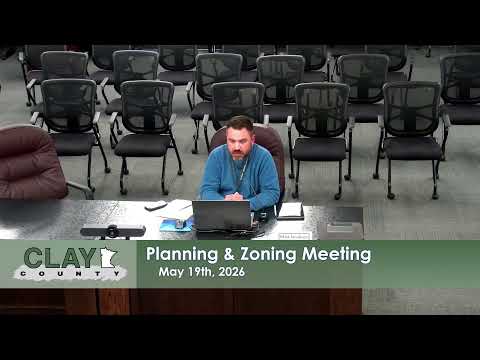
Clay County staff brief commissioners on data center impacts and limits of local authority
Summary
Staff presented an overview of data center types, infrastructure needs and potential local impacts — including power, water and noise — and commissioners discussed proactive ordinance options and the county's limited authority over projects above 50 megawatts that fall under the Public Utilities Commission.
Planner Matt (speaker 3) gave a detailed presentation to the Clay County Planning Commission on data centers, outlining the different facility types, critical infrastructure needs and the kinds of local impacts counties should anticipate.
Matt defined four data-center types — enterprise, edge/modular, colocation and hyperscale — and said siting decisions typically hinge on access to electricity, fiber, cooling water and zoning/incentives. He described typical scales (small centers measured in single-digit megawatts versus hyperscale campuses of 100+ megawatts) and noted that hyperscale installations often need dedicated substations and transmission.
Using national examples, Matt warned of infrastructure stress and legal pitfalls: Loudoun County, Virginia, demonstrates concentrated growth and high power demand; a Prince William County rezoning was later invalidated after inadequate public notice; West Des Moines saw a major data center pay for wastewater upgrades; and several projects elsewhere ran into air-permit or PUC-level limits after building fast.
Matt highlighted three local policy levers: defining data centers in the land-development code, requiring conditional use permits with measurable standards (setbacks, screening, noise limits, water-use reporting, generator limits) and planning for phased expansion. He also told commissioners that large energy or water uses could trigger state review—water appropriations through the Minnesota DNR and energy/PUC review for facilities exceeding certain thresholds.
Commissioners asked how jurisdictional notice and project initiation typically occur; Matt said inquiries can come through varied channels and that staff has fielded at least one inquiry for Clay County. Commissioners suggested researching ag-preservation overlays, preparing a standardized PUC comment template and educating townships about possible ordinance language. Several members urged proactive preparation so the county can provide substantive comments if a project reaches the PUC.
On related business, a commissioner raised resident concerns about very large solar projects (over 50 MW). Matt explained that projects above that threshold are under Public Utilities Commission jurisdiction and that a county ordinance would likely be preempted, though the county can still submit recommendations and comment during PUC review.