Get Full Government Meeting Transcripts, Videos, & Alerts Forever!
Get email alerts on the Historic Preservation topic
No spam. Unsubscribe anytime.
Sanford preservationists recount early fights, restorations and Georgetown’s recent inclusion
Summary
Original members of Sanford’s Historic Preservation Board told stories of restoring homes, early ordinance changes and the emotional reasons they fought to save the city’s buildings during a takeover episode of the Sanford Says podcast; they also described the board’s role in adding Georgetown to preservation protections.
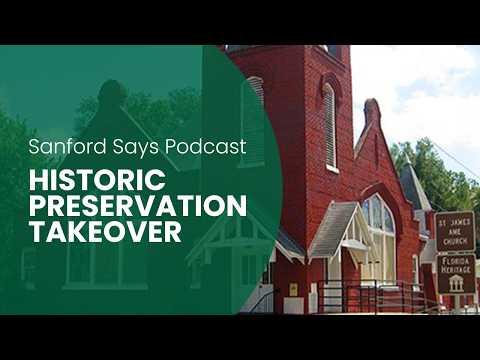
Tammy Agnini, host of the Sanford Says podcast, kicked off a takeover episode by introducing several of the city’s early historic preservation volunteers and asking them to recall the origins and impact of Sanford’s preservation movement. "This is the Sanford Historic Preservation takeover of Sanford Says," she said as the program began.
Longtime participants described how preservation in Sanford grew from informal activism to formal protections that reshaped neighborhoods. Jerry Mills, who said he was selected as the first chairman of the Sanford Historic Preservation Board, described the early emotional stakes of the work: "I was in tears," he said of his first involvement, recalling how community members pressed to document and save local architecture. Alec, another early board member, said preservationists learned from older planning work and adapted it for Sanford’s needs as the downtown and residential districts evolved.
Speakers cited concrete policy changes and local examples. One participant described an early ordinance that required houses to revert to single-family use if utilities were shut off for six consecutive months; members said that change substantially reduced multifamily conversions and shaped the district’s housing stock. Panelists also gave specific financial context: several speakers recalled buying houses in the tens of thousands of dollars decades ago and cited high mortgage rates in the early years (one speaker noted a rate of about 19.5 percent for an early purchaser).
The group named local landmarks central to the district’s history. Panelists discussed the Pico Building and the Montezuma hotel as buildings that shaped local memory; they also described successful restorations such as the Deming house and the long stewardship required to keep older structures in use. A committee member noted that rectified historic photographs commissioned decades ago by the board (by photographer John Markham) remain important archival artifacts and may be stored in city planning files.
Speakers described tensions that come with preservation enforcement. The host and others told an anecdote about a homeowner who painted a house a color not on the approved palette and then publicly protested the board’s action; another told of a commercial owner who removed wood windows and left a building boarded up until it later deteriorated. Panelists said those controversies can make volunteer service on the board difficult because members often decide cases concerning neighbors and friends.
Several contributors highlighted recent work to expand protections to historically Black neighborhoods. Panelists said the recent inclusion of Georgetown into a preservation district came at residents’ request and was intended to protect neighborhood character and prevent large-scale replacements, while acknowledging codes and application can differ across areas.
The episode closed with Agnini thanking the former board members and praising current city staff support; she also noted staff member Julie’s contribution and that local officials remain supportive of preservation. "I’m standing on the shoulders of giants," Agnini said, crediting earlier activists for the protections current residents now enjoy.
The program offered oral-history reflections rather than formal proposals. Board members and early volunteers emphasized stewardship, communal memory and the practical challenges of balancing preservation with property owners’ expectations. The episode concluded with a call to continue educating new residents about the district’s history and rules.