Get Full Government Meeting Transcripts, Videos, & Alerts Forever!
Get email alerts on the Maternal Mortality Forensic Investigation topic
No spam. Unsubscribe anytime.
Chief Medical Examiner urges forensic pathologists to increase investigations of maternal deaths
Summary
At the May Maternal Mortality Review Committee meeting, Maura DeJoseph of the Office of the Chief Medical Examiner described a NAME position paper and urged medical examiners to accept jurisdiction, increase autopsy use and join maternal mortality review committees to improve cause-of-death data and prevention.
Maura DeJoseph, representing the Office of the Chief Medical Examiner, told the Maternal Mortality Review Committee at its May meeting that forensic pathologists nationwide should do more to investigate maternal deaths and partner with review committees to improve data and prevention.
DeJoseph said she and colleagues prepared a position paper for the National Association of Medical Examiners (NAME) and presented it at NAME’s interim meeting. "Autopsy to advocacy: How does forensic pathology inform maternal health?" framed the paper’s recommendations, she said, and urged jurisdictions to report maternal deaths to medical examiner offices, accept jurisdiction where appropriate and keep a low threshold for full autopsy.
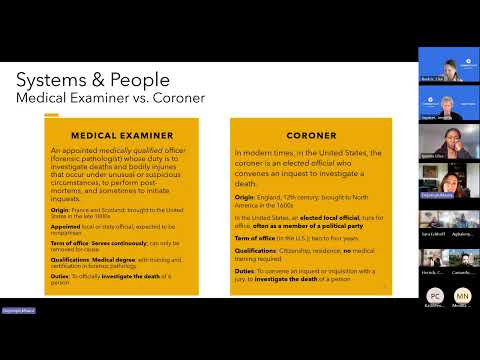
The recommendations respond, DeJoseph said, to wide variation in U.S. death-investigation systems. She contrasted medical examiner systems—where pathologists are appointed and medically trained—with coroner systems, which are often elected and may not require medical training. That variability, she said, "makes it challenging from the level of the CDC to take all the information about maternal deaths and try to do something with it when even amongst the people who issue death certificates, it can be so varied."
DeJoseph cited national estimates to describe the scale and gaps in information: "It’s estimated there’s about 3,500 annual deaths across the country of persons who’ve been pregnant within one year of the death. Of those, about 800 to 1,000 were actually pregnancy-related." She added that only about 41 percent of maternal deaths nationally receive an autopsy, and that limited autopsy use—often driven by family objection or workforce shortages—can leave clinically important questions unresolved. "If I only have toxicology results, I can’t say that I didn’t find anything else," she said.
Framing the issue in economic as well as clinical terms, DeJoseph said the annual cost of maternal deaths is roughly $10,400,000,000 and argued that relatively small additional autopsy capacity in some states could support prevention efforts, noting that in the highest-burden states the additional number of autopsies required would be modest in absolute terms.
The NAME paper, DeJoseph said, recommends that medical examiners take steps to improve death certificates’ accuracy, participate in maternal mortality review committees, and accept educational support and technical guidance when jurisdictions are asked to do more. "We really wanna make sure that we get as much information as possible," she said, urging clinicians and committee members to call their office when an autopsy could add clarity.
The committee’s chair, Lisa Budris, identified herself at the meeting as an epidemiologist at the Department of Public Health and co-chair of the committee and thanked DeJoseph for the presentation. The committee reviewed its April minutes, and the chair moved to approve them; the motion was seconded and the transcript records no edits or objections. The chair then announced an executive session to discuss confidential matters related to maternal deaths; a motion to enter executive session was made and seconded and the committee proceeded into executive session before adjourning.
The presentation highlighted gaps in national practice—variation in death-investigation systems, low autopsy rates and resource constraints—and urged stronger collaboration between medical examiners and maternal mortality review committees as a means to improve cause-of-death data and prevention opportunities. The committee did not record any public comment during the meeting, and next procedural steps for follow-up were not specified on the public transcript.