Get Full Government Meeting Transcripts, Videos, & Alerts Forever!
Get email alerts on the Land Use topic
No spam. Unsubscribe anytime.
Council adopts McCartney Ranch PAD amendment after heated public comment; apartments reduced on Parcel 5
Summary
The council approved a general-plan amendment and a PAD amendment for the Villages at McCartney Ranch that expands a PAD to about 75 acres, permits a large retail corner (Walmart anchor), reduces multifamily acreage (Parcel 5 converted to single-family small lots) and includes development restrictions and buffer commitments; planning commission had recommended approval 4–2.
The Casa Grande City Council voted to approve a minor general-plan amendment (Resolution 5273.42) and to adopt a major PAD amendment (Ordinance 1178.2470.4) for the Villages at McCartney Ranch after a public hearing that included sustained opposition from nearby residents.
City planner James presented the proposal to expand the PAD to roughly 75 acres at the southeast corner of McCartney Road and Pinal Avenue. The plan designates about 38.7 acres for commercial uses and about 36.1 acres for residential uses. The applicant and staff said Commercial A would host a large, single-user shopping center anchored by Walmart (applicant-estimated anchor size ~182,000 sq ft) and that Commercial C would be limited to a 25-foot maximum height and explicitly prohibit gas stations and car washes to reduce neighborhood impacts.
Under the revised proposal the applicant removed multifamily from Parcel 5 and made it a single-family-lotted area with 40-foot minimum lot widths and a maximum height of two stories (28 feet). James said Parcel 1 remains eligible for multifamily up to 20 dwelling units per acre (a theoretical yield of about 310 units at that density), and staff emphasized that the recent changes both reduce multifamily acreage and add site-specific development standards, including 20% open space requirements and required setbacks/buffers.
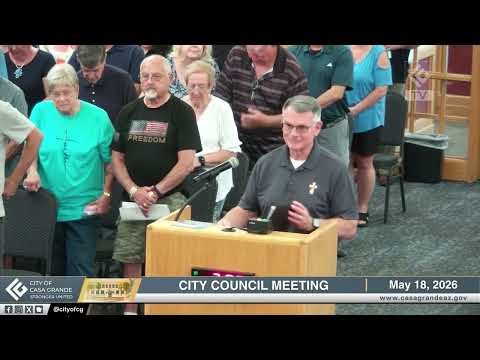
The proposal earlier had been forwarded by planning commission with a 4–2 recommendation. Neighbors from the Coyote Ranch and Cornerstone Ranch communities spoke at length in the public hearing. Kirk Bauer said the developer prioritized profit over community character: "the primary focus appears to be financial gain of the developers and the anchor store rather than the well-being of the local residents." Debbie Yost, a long-time real-estate broker, urged denial or tabling, saying she believed proposed lot sizes and density would be permanent once approved.
The applicant’s representative, Julie Vermillion of CVL Consultants, said the site carries a certificate of assured water supply and that Parcel 5 is intended for ownership-product single-family lots rather than rental 'built-to-rent' product. "The single family residential parcel, Parcel 5, ... is subject to that certificate of assured water supply," Vermillion said.
Council discussion acknowledged strong neighborhood concern but noted substantive concessions: removal of apartments from Parcel 5, a two-story height cap, expanded buffers and limitations on certain commercial uses. Supporters on the council cited property-rights considerations and the developer’s concessions; opponents argued the changes still increased long-term density. On roll call the council approved the general-plan minor amendment (Resolution 5273.42) and the PAD ordinance (Ordinance 1178.2470.4) by recorded votes that carried the motions.
Next steps: staff said that, if approved, subsequent site-plan and plat reviews would be administrative with public notification; deviations from PAD development standards would require separate public hearings and zoning actions.