Get Full Government Meeting Transcripts, Videos, & Alerts Forever!
Get email alerts on the Water Rates topic
No spam. Unsubscribe anytime.
Brigham City hears options to raise water rates after spring supply scare
Summary
City engineer Brett Jones told the council a recent Manaway-area failure and long-term aging mains left Brigham City facing roughly a $6 million annual shortfall for system replacement; staff recommended options ranging from the mayor's proposed $30 base fee to a full-recovery level near $80 a month.
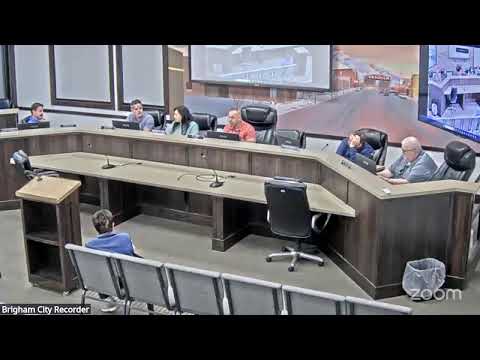
Brigham City's council spent its 5 p.m. work session on May 21 reviewing options to shore up the water utility after a spring infrastructure failure and years of underfunded replacements.
City engineer Brett Jones said the city's sources average about 20,000,000 gallons per day — roughly 9,400,000 gpd from Manaway springs, 2,000,000 gpd from wells in the canyon and about 8,700,000 gpd from in-town sources — and that seasonal demand can spike to about 17,000,000 gpd in summer. He said a failed deep corrugated-metal drain line at a wetland mitigation site near Manaway temporarily threatened sewer infrastructure and the penstock lines that deliver spring water; staff kept water service running but incurred significant emergency costs.
"Those springs and wells are really the backbone of our system," Jones said. "We produce about 20,000,000 gallons a day on average, but in the summer demand gets close to that supply and when you have a failure you get nervous." Jones added that the city secured a large grant to replace penstock lines in the canyon but still faces aging mains and other deferred replacement needs.
Jones framed water-rate discussions around three funding categories: operations and maintenance (O&M), system replacement and capital projects. He said the current $23 monthly base fee covers O&M, but the replacement category is dramatically underfunded. "We're only covering about $2,000,000 of replacement; we're about $6,000,000 short a year to fully replace the system," he said, adding that a full-recovery base would be near $78'$80 a month.
The mayor's proposed budget includes a $30 base fee. Staff said that level would free roughly $1,000,000 a year for waterline capital projects and materially improve the fund, while acknowledging it would not fully close the replacement gap. Council members discussed alternatives: raising the base fee, increasing tiered overage charges, or a staged approach. Multiple council members said they were sensitive to affordability, particularly for fixed-income residents.
Council members and staff traded specifics: how many customers fall in the 0'to'7,000-gallon tier (about 59% of connections, by staff's account), how overage changes affect summer bills, and whether to shift park irrigation to secondary (nonculinary) water to reduce culinary demand. Jones noted the city has roughly 40,650 linear feet of 4-inch mains (state minimum is 8-inch), a major long-term replacement need estimated at about $3.2 million for those small mains alone.
No formal vote was taken; the council asked staff to return with more scenarios and spreadsheets. Council members scheduled continued deliberations on the water-rate proposal as part of upcoming work sessions and asked staff to provide customer-impact breakdowns and prioritized capital-project lists so the council could weigh revenue options against which projects could be deferred.
What happens next: staff will provide more detailed scenarios and project priorities in follow-up meetings; final council action on rates is scheduled as part of the budget process in June.